
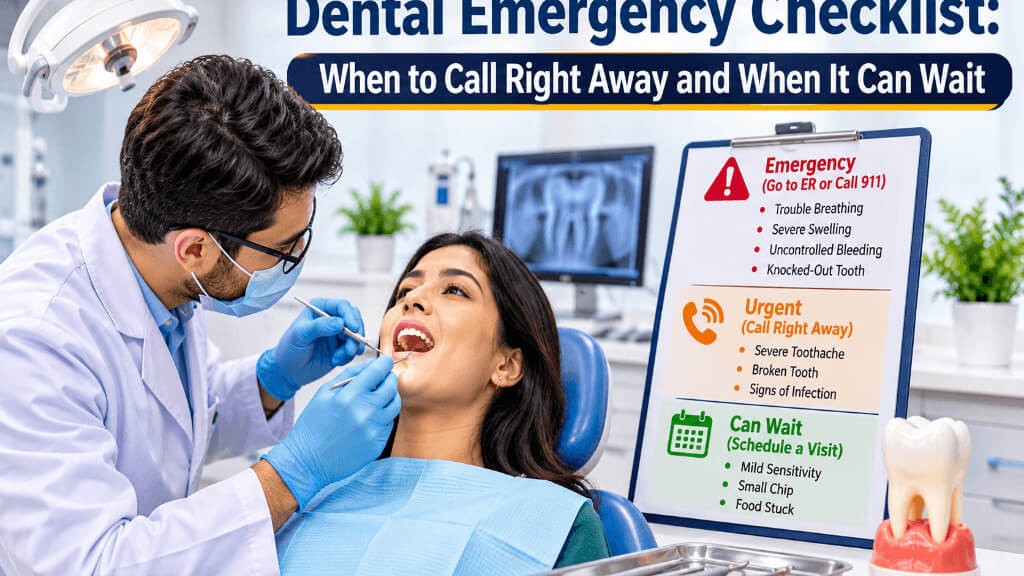
Call a dentist right away for uncontrolled bleeding, facial swelling, trouble breathing or swallowing, a knocked-out permanent tooth, severe pain, or signs of a dental infection. Some dental problems can wait for a scheduled appointment, while others need same-day care or emergency medical attention. This guide helps you sort out which is which, without panic.
When something goes wrong with your mouth, it helps to know what can wait and what cannot. This guide is written for adults in tooth pain and for parents handling a child’s dental injury. It also covers broken teeth, lost crowns or fillings, bleeding gums, swelling, and braces problems, and it can help you decide whether a trip to the emergency room is needed..
Dental Emergency Checklist
Go to the emergency room or call 911 now: trouble breathing, trouble swallowing, significant facial swelling, or bleeding that will not stop after gentle pressure with clean gauze.
Call a dentist right away: a knocked-out permanent tooth (keep it moist and handle it by the crown), severe pain, or signs of infection such as swelling, fever, a bad taste, or pus.
Call the same day: a broken or cracked tooth, a persistent toothache, or a lost crown or filling that hurts. Call soon: a broken braces wire that irritates your mouth.
Usually can wait for a scheduled visit: mild sensitivity, a small chip without pain, food stuck between teeth, or minor gum irritation. Call for advice if you are unsure. This is a general guide, and your symptoms may differ.
What Counts as a Dental Emergency?
True Dental Emergencies
These may need immediate care:
- Uncontrolled bleeding
- Facial swelling, or trouble breathing or swallowing
- A knocked-out permanent tooth
- Severe pain
- A dental abscess (a pocket of infection near a tooth or gum) or other signs of infection
- A broken tooth with sharp edges, or other dental trauma
Urgent Dental Problems
These usually need prompt attention, often the same day or next business day:
- A lost crown or filling
- A broken or cracked tooth
- A toothache or gum pain
- A broken braces wire
- Wisdom tooth pain
Non-Emergency Issues
These can usually wait for a routine visit:
- Mild sensitivity
- A small chip without pain
- Food stuck between teeth
- Minor gum irritation
Timing matters because some problems can worsen quickly, while others can wait. Not every dental problem is an emergency, and not every broken tooth needs an emergency visit.
When to Call a Dentist Right Away: Knocked-Out Permanent Tooth
Call right away. The American Dental Association (ADA) explains that a knocked-out permanent tooth should be kept moist, and that you should call the dentist and seek care as soon as possible. The American Association of Endodontists advises seeking care within 30 minutes, though a tooth may sometimes still be saved after an hour or more. If you need an emergency dentist in Commack, call before you head in so the office can prepare.
What to Do
- Handle the tooth by the crown (the chewing surface), not the root.
- Rinse it gently if it is dirty.
- Try to place it back in the socket, if possible.
- If you cannot, keep it moist: in milk, between the cheek and gums, or in an ADA-accepted tooth-preservation product.
- Call the dentist right away and get there as soon as possible.
What Not to Do
- Touch or scrub the root
- Let the tooth dry out
- Wrap it in a dry tissue
- Use alcohol, hydrogen peroxide, or harsh chemicals on it
- Delay care
What this means for you: if a child knocks out a tooth during sports, first check whether it is a permanent tooth or a baby tooth. Baby teeth usually are not put back in the socket, so call the dentist for guidance either way.
When to Go to the Emergency Room
Go to the emergency room or call 911. The ADA and the American Academy of Pediatric Dentistry identify uncontrolled bleeding, facial or oral swelling that may affect the airway, and facial trauma as potentially life-threatening emergencies that need immediate care.
Go for:
- Trouble breathing or swallowing
- Significant facial swelling
- Bleeding that does not stop
- Fever with swelling
- Serious facial trauma
Bring your medication list and relevant medical information, and contact the dental office after urgent medical care. Do not wait for symptoms to worsen.
Toothache: When It Can Wait and When It Cannot
Can wait: mild sensitivity, with no swelling. Monitor it and schedule a routine visit.
Call the same day: a severe or persistent toothache, or a toothache that wakes you from sleep.
Call right away or seek urgent care: a toothache with swelling or fever.
The ADA explains that for a toothache you can rinse with warm water, gently floss to remove trapped food, and avoid placing aspirin directly on the tooth or gums. A cold compress can help with swelling. Call the dentist if pain is severe or does not go away.
What this means for you: if you have mild sensitivity but no swelling, you can usually schedule a routine visit. If the pain is severe or returns, call.
Broken, Chipped or Cracked Tooth
Call the same day if the tooth is painful, has sharp edges, or comes with swelling or bleeding. Call for advice if the chip is minor and painless, since it can often wait for a scheduled visit.
The ADA explains that for a cracked tooth you can rinse with warm water and use a cold compress to reduce swelling. Also:
- Save any broken piece, if you can
- Avoid chewing on that side
- Watch for sharp edges that irritate your tongue or cheek
A cracked tooth with no pain still deserves a call, because cracks can worsen over time.
What this means for you: if you break a tooth while eating, rinse gently, keep the piece, and call for guidance. Do not try to glue it back.
Dental Abscess and Swelling
Call right away. A dental abscess is a pocket of infection that can form near a tooth or gum. Only a dentist can diagnose it. Possible symptoms include severe pain, swelling, fever, a bad taste, pus, tender lymph nodes, and trouble swallowing or breathing.
Swelling with fever, trouble breathing, or trouble swallowing needs urgent evaluation. In the meantime:
- Call the dentist right away, and seek emergency care if symptoms are severe
- Do not pop or drain the area
- Do not apply heat
- Follow the dentist’s instructions
What this means for you: if you have facial swelling and a fever, do not wait for an appointment. Seek urgent care.
Bleeding Gums and Oral Bleeding
Can wait: minor gum bleeding while brushing. Mention it at your next visit. Call soon: gums that bleed often or persistently.
Call right away or go to the ER: bleeding that will not stop, including after an extraction. In the meantime:
- Rinse gently with warm water
- Apply gentle pressure with clean gauze
- Avoid vigorous rinsing and smoking
- Call the dentist if bleeding continues
Lost Filling, Lost Crown or Broken Braces
Call soon, usually the same day or next business day. A lost filling or crown can leave the tooth exposed and sensitive, and a broken braces wire can poke your cheek or gums.
- Keep the area clean.
- Avoid chewing on that side.
- Use orthodontic wax on a poking wire, if you have it.
- Do not try to glue a crown back in place.
- Call your dentist or orthodontist for advice.
If you wear braces, call your orthodontist first about a broken wire.
What this means for you: if you lose a crown or filling but have no pain, swelling, or bleeding, you may be able to wait until the next business day. Call for advice anyway.
When a Dental Issue Can Wait
Schedule a routine visit for mild sensitivity, a small painless chip, food stuck between teeth, or minor gum irritation. Meanwhile, monitor symptoms, keep the area clean, and avoid hard or sticky foods. Call sooner if symptoms worsen.
What to Do When You Call
Have This Ready
- Your name, date of birth, and phone number
- Insurance information, if you have it
- Your medical history, medications, and allergies
- A description of your symptoms, when they started, and how severe they are
- Any swelling, bleeding, or fever
- Any recent dental work or injury
Questions to Ask
- Is this an emergency, and can I be seen today?
- What should I do until I arrive?
- Should I go to the emergency room instead?
- What should I bring (for example, a tooth or tooth fragment)?
If you are unsure, you can contact Commack Family Dental for urgent dental care and ask for guidance. Do not stop or change prescribed medication unless the prescribing clinician tells you to.
How Commack Family Dental Can Help
Commack Family Dental provides general, restorative, cosmetic, and implant dentistry in Commack, NY, and offers emergency dental care. Dr. Steven Klein has experience in cosmetic, implant, and restorative dentistry, including root canal treatment, and in oral surgery such as extractions, bone grafting, and implant placement.
The office uses an OP300 CT scanner for 3D dental imaging and offers complimentary consultations. It is at 647 Commack Road, Commack, NY 11725. Call 631-759-8284 to ask whether your symptoms need urgent care.
If you are unsure whether your symptoms need urgent care, call Commack Family Dental for guidance and to request an appointment.
Dental Emergency Checklist
- Call the dentist for severe pain, swelling, or a fever.
- Call right away for a knocked-out permanent tooth.
- Call for a broken tooth or a lost filling or crown.
- Call if bleeding will not stop.
- Go to the emergency room for trouble breathing or swallowing, or severe symptoms.
- Bring any broken tooth fragment.
- Bring your medication list and relevant medical information.
- Follow the dentist’s instructions.
- Keep follow-up appointments.
Frequently Asked Questions
Q. What counts as a dental emergency?
A dental emergency may include uncontrolled bleeding, facial swelling, trouble breathing or swallowing, a knocked-out permanent tooth, severe pain, or signs of a dental infection.
Q. When should I go to the emergency room for a dental problem?
Go if you have trouble breathing, trouble swallowing, uncontrolled bleeding, or significant facial swelling. Call 911 if symptoms are severe.
Q. Is a toothache an emergency?
It may be, if the pain is severe or persistent, or paired with swelling, fever, or trouble breathing. Mild sensitivity usually can wait for a scheduled visit.
Q. What should I do if my tooth is knocked out?
Handle the tooth by the crown, keep it moist, and call a dentist right away. Try to place it back in the socket if you can, and do not touch the root.
Q. Is a broken tooth an emergency?
It may be, if it is painful, sharp, or comes with swelling or bleeding. A small, painless chip often can wait, but call for advice.
Q. Can I wait until tomorrow if I have a lost crown or filling?
You may be able to wait until the next business day if there is no pain, swelling, or bleeding. Still call the dentist for advice.