
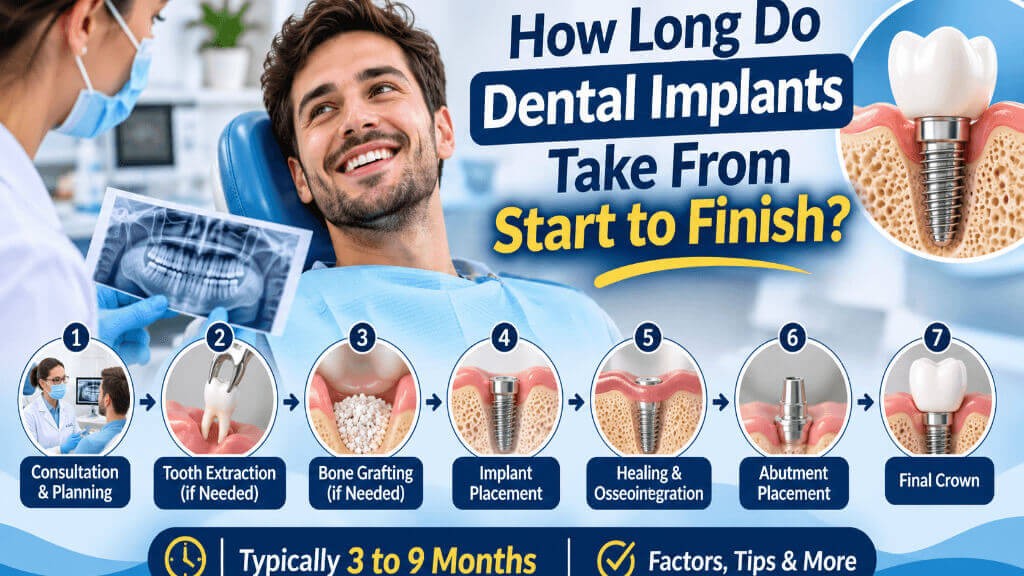
A dental implant often takes several months from the first consultation to the final crown, with many cases lasting about three to nine months depending on healing, bone support, and whether extra procedures are needed. The placement appointment itself is relatively short. Most of the timeline is healing, especially osseointegration, when the jawbone fuses with the implant.
If you are planning for an implant and want to know what the months ahead will look like, this guide walks you through each stage. It is written for patients missing one or more teeth, including those who may need an extraction or bone grafting first. It also helps anyone weighing an implant-supported bridge or denture, and first-time patients who want the full picture before they begin.
Dental Implant Timeline at a Glance
The process starts with one or two visits for an exam, imaging, and a treatment plan. If a tooth needs to come out, or the jaw needs a bone graft, those steps add weeks or months before the implant goes in. Placement is usually a single visit.
Then comes the longest stage. Osseointegration typically takes about three to nine months, and the abutment (a small connector post) is attached afterward. Gums may need at least two weeks to heal around it before the final crown, bridge, or denture is placed. Follow-up care continues after that. This is a general guide, and individual timelines vary.
What Affects the Dental Implant Timeline?
Two patients can get the same implant and finish months apart. These factors matter most:
- Number of missing teeth: replacing one tooth may take less planning than several teeth or a full arch.
- Location: upper back implants may need a sinus lift, and lower jaw implants require careful planning around nerves.
- Jawbone health: enough bone height, width, and density supports a more straightforward timeline.
- Extraction or grafting needs: these add healing time before placement.
- Gum health: gum disease may need treatment first.
- Medical history and smoking: conditions that affect healing, and smoking, may influence the plan and the pace.
- Type of restoration: a single crown, bridge, or implant-supported denture needs different planning and visits.
- Healing response: every patient heals at a different rate.
For a closer look at the factors behind these decisions, see dental implant candidacy.
Step 1: Consultation and Treatment Planning
What Happens at the Consultation
The dentist reviews your medical and dental history, medications, allergies, missing teeth, gum health, bone support, bite alignment, and goals.
Imaging and Diagnostics
You may have dental X-rays, panoramic X-rays, a 3D CT scan, digital impressions, and digital treatment planning. The Commack Family Dental website states that the office uses an OP300 CT scanner, a 3D imaging system that helps inspect patient anatomy.
How Long This Stage Takes
One or more visits, depending on the complexity of your case.
What Happens Next
You receive a treatment plan that may include extraction, bone grafting, a sinus lift, implant placement, a healing period, abutment placement, and the final restoration. Ask for it in writing.
What this means for you: if you have adequate bone and healthy gums, planning may move quickly. If you have gum disease or other issues, your dentist may address them first.
Step 2: Tooth Extraction, if Needed
A damaged or failing tooth may need to come out before an implant. The extraction site may then need time to heal before placement. A socket preservation graft may be placed at the time of extraction to help preserve bone.
What this means for you: if you need an extraction, expect extra healing time before the implant. Ask whether placement can happen sooner in your case.
Step 3: Bone Grafting, if Needed
Bone grafting may be needed when the jaw lacks enough height, width, or density to support an implant. Not every patient needs it. Grafting can add weeks or months to the timeline, and the Cleveland Clinic explains that a bone graft may need at least three months to heal, while larger grafts may take nine to 12 months.
Your dentist will decide whether:
- The implant can be placed right away
- A small graft can be placed with the implant
- The graft must heal before implant placement
- Another option is more appropriate
What this means for you: if you need a sinus lift for an upper back implant, expect it to happen before placement or, in some cases, during it, depending on your anatomy.
Step 4: Implant Placement
What Happens
The dentist places a titanium implant post into the jawbone. Local anesthesia is commonly used, and sedation may be available for anxious patients.
How Long the Appointment Takes
It depends on the number of implants, the need for grafting, and the complexity of the case.
Healing Cap
A healing cap may be placed over the implant to protect it while it heals. The European Federation of Periodontology explains that it is removed once healing is complete.
What this means for you: if you are anxious about surgery, tell the office beforehand so the team can explain the steps and discuss comfort options.
Step 5: Osseointegration and Healing
What Is Osseointegration?
Osseointegration is the process where the jawbone fuses with the implant. It creates the stable foundation the final restoration needs. The Cleveland Clinic explains that it can take three to nine months, and the European Federation of Periodontology describes implant healing as about two to six months. The range varies by patient and plan.
What to Expect Along the Way
- First few days: soreness, swelling, bruising, and minor bleeding are common.
- First week: most patients begin to feel more comfortable.
- First month: the implant continues to heal and integrate.
- Several months: osseointegration continues until your dentist confirms the implant is stable.
What Patients Can Do
Follow your post-operative instructions, keep your mouth clean, eat soft foods if advised, avoid smoking and hard or sticky foods, avoid strenuous activity until cleared, and attend follow-up visits. Your dentist may check healing and stability periodically.
Normal Healing vs. Warning Signs
Mild soreness, swelling, and bruising that improve over days are normal. Contact the office if pain or swelling worsens, you notice pus or a bad taste, bleeding does not stop, or the implant feels loose.
Step 6: Abutment Placement
The abutment is a small connector post that attaches to the implant and supports the final restoration. It is placed after the implant has healed and integrated with the jawbone. Mayo Clinic notes that gums may need at least two weeks to heal after abutment placement before the artificial tooth is attached. The European Federation of Periodontology describes the healing cap being replaced with an abutment at this stage.
Step 7: Final Crown, Bridge or Denture
The final restoration is the visible replacement tooth or teeth. It is placed only after your dentist confirms the implant is stable. Common types include:
- Implant crown: replaces one tooth.
- Implant-supported bridge: replaces several teeth in a row.
- Implant-supported denture: replaces multiple or all teeth with a denture supported by implants.
- Full-arch restoration: replaces all teeth in one arch.
This stage may take one or more visits, depending on the type and whether impressions or digital scans and lab work are needed. For more on crown options, see dental crowns and bridges.
How Long Does Each Stage Take?
| Stage | Typical timeframe | What affects timing |
| Consultation and planning | 1 to 2 visits | Complexity, imaging, treatment goals |
| Tooth extraction, if needed | Before implant placement | Healing needs, bone preservation |
| Bone grafting, if needed | Weeks to months | Graft size, location, healing response |
| Implant placement | 1 visit | Number of implants, need for grafting |
| Osseointegration | About 3 to 9 months | Bone quality, health, location, healing response |
| Abutment placement | 1 visit | Implant stability, gum health |
| Gum healing after abutment | At least 2 weeks | Individual healing response |
| Final restoration | 1 or more visits | Type of restoration, impressions, lab work |
| Follow-up care | Ongoing | Healing, stability, oral health |
These are general ranges. Individual timelines vary, and Mayo Clinic notes the entire process can take many months, with much of that time devoted to bone healing.
How Long Does It Take for One Tooth Versus Several?
One Missing Tooth
A patient with adequate bone and healthy gums may finish in several months. A patient who needs an extraction or a graft first will add healing time before placement.
Some patients receive a temporary crown at the time of placement. However, the final crown is usually placed after healing.
Multiple Missing Teeth
An implant-supported bridge, denture, or full-arch restoration can take more planning and more appointments. Multiple implants, grafting, and complex restorations can extend the overall timeline.
What this means for you: if you are considering a bridge or denture on implants, ask how many implants your plan needs and how that affects the number of visits.
How Many Appointments Does a Dental Implant Take?
A typical case may include a consultation, imaging, treatment planning, implant placement, follow-up visits, abutment placement, and the final restoration, plus extraction or grafting visits if needed. The number varies with the number of implants, extraction or grafting needs, the type of restoration, your healing response, and case complexity.
Same-Day Implants
Some patients may be candidates for an immediate temporary crown or restoration. That depends on bone support, gum health, and treatment goals, and it is not an option for everyone. The final restoration still usually comes after healing.
What this means for you: if you want a same-day crown, ask whether your bone and gums make it possible.
What Can Delay a Dental Implant Timeline?
- Gum disease: may need treatment before placement.
- Bone loss: may require grafting or extra healing.
- Smoking: can affect healing and may delay treatment.
- Medical conditions: conditions that affect healing may change the plan.
- Infection: may need treatment first.
- Poor oral hygiene: may increase the risk of complications.
- Missed appointments: can push back the next stage.
- Complex restorations: may take longer to plan and fabricate.
What this means for you: if you smoke or have a medical condition, tell your dentist early. It lets the team plan realistic timing.
How to Help Your Implant Stay on Schedule
- Follow post-operative instructions and take medication as prescribed or recommended.
- Keep regular dental visits so your dentist can monitor healing.
- Brush twice daily, clean between your teeth daily, and keep the gumline clean.
- Avoid smoking, chewing ice, biting hard objects, and using your teeth as tools.
- Do not ignore gum bleeding or swelling. Call the office.
How Commack Family Dental Can Help
Commack Family Dental provides general, restorative, cosmetic, and implant dentistry in Commack, NY. Dr. Steven Klein has experience in cosmetic, implant, and restorative dentistry, including oral surgery such as extractions, bone grafting, and implant placement. He was awarded a Fellowship in the International Congress of Oral Implantologists.
The office uses an OP300 CT scanner for 3D dental imaging and offers complimentary consultations. It is located at 647 Commack Road, Commack, NY 11725. You can call 631-759-8284 with questions.
Wondering how long a dental implant will take in your case? Schedule a dental implant consultation to review your bone health, gum health, and treatment options.
Dental Implant Timeline Checklist
- Schedule a consultation.
- Share your medical history and all medications and supplements.
- Complete imaging.
- Review your treatment plan in writing.
- Ask whether you need an extraction, a bone graft, or a sinus lift.
- Ask how long healing will take.
- Ask how many appointments you will need.
- Ask when the final crown will be placed.
- Follow post-operative instructions.
- Keep follow-up appointments.
- Maintain good oral hygiene and avoid smoking.
- Contact the office with concerns.
Frequently Asked Questions
Q. How long does a dental implant take from start to finish?
A dental implant often takes several months from consultation to final crown, with many cases lasting about three to nine months. Healing and treatment complexity decide where yours falls.
Q. How long does it take for a dental implant to heal?
Osseointegration, when the jawbone fuses with the implant, can take three to nine months. Some sources describe implant healing as about two to six months, so ask your dentist for your own range.
Q. How long after implant placement can I get my crown?
The final crown is usually placed after the implant has healed and your dentist confirms it is stable. This may take several months.
Q. Does a bone graft make the implant timeline longer?
Yes, bone grafting can add time. The graft may need weeks or months to heal before the implant can be placed.
Q. How many appointments does a dental implant require?
It varies by case. A typical timeline may include a consultation, imaging, treatment planning, implant placement, follow-up visits, abutment placement, and the final restoration.
Q. Can I get a dental implant and crown on the same day?
Some patients may be candidates for an immediate temporary crown. However, the final crown is usually placed after the implant has healed and integrated with the jawbone.