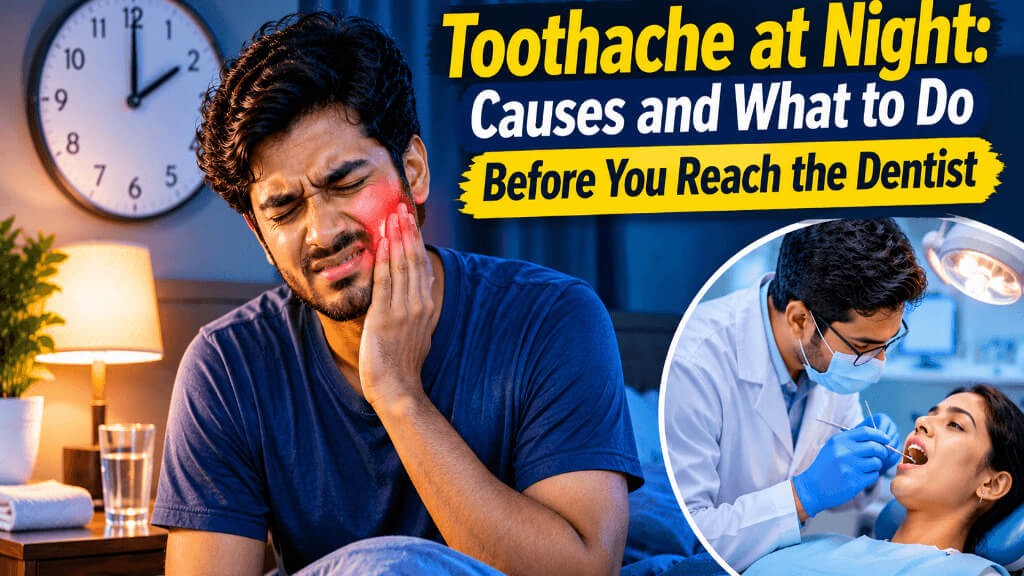
Toothache at Night: Causes and What to Do Before You Reach the Dentist

A toothache at night is often caused by tooth decay, a cracked tooth, gum inflammation, an infection, or pressure changes that make existing dental pain feel worse when you lie down. Lying flat can make swelling and pressure more noticeable, and quiet hours leave fewer distractions.

You can use safe comfort measures while you wait for care, but they do not replace a dental exam. Contact a dentist promptly if your pain is severe, keeps coming back, or comes with swelling.

Why Tooth Pain Can Feel Worse at Night

Tooth pain often seems stronger after dark. When you lie down, blood flow and pressure in your head and mouth can change. As a result, a tooth that felt fine during the day may start to throb. In addition, you have fewer distractions at night, so you notice the pain more clearly.

Grinding or clenching during sleep can also irritate a tooth or jaw. Many people do this without knowing it. If you wake up with a sore jaw or sensitive teeth, mention it to your dentist.

A small problem can become harder to ignore when you finally try to rest. Inflammation or infection may worsen over time, so pain can build as the evening goes on. Meanwhile, a cracked tooth or damaged filling may cause sharp pain with biting or temperature changes.

For comfort, you can raise your head slightly with an extra pillow if that feels good, and avoid very hot, cold, or sweet foods. However, pain that keeps getting stronger may point to an infection. In that case, seek a prompt dental evaluation.

Common Causes of a Toothache at Night

Tooth pain is a signal, not a diagnosis. Several different problems can cause it, and only a dentist can tell which one applies to you.

Picture this. You fall asleep fine, then wake at 2 a.m. with a dull throb in one tooth. Or you chewed on something hard at dinner, and now a filling feels sharp when you bite down. These are common ways a toothache at night begins.

Possible cause What it may feel like Other signs What to do
Tooth decay Sharp, throbbing, or sensitivity to sweet foods Visible cavity or food trapping Schedule a dental exam
Cracked tooth Sharp pain when biting or chewing Pain with temperature changes Avoid chewing on that side and call the dentist
Damaged filling or crown Sensitivity or pain when biting Loose, broken, or missing restoration Arrange a dental visit
Gum inflammation Sore, swollen, or bleeding gums Redness or tenderness Schedule a dental cleaning and exam
Dental abscess Throbbing pain, pressure, or a bad taste Swelling, pus, fever, or bad breath Seek urgent dental care
Food trapped between teeth Localized pressure or soreness Floss may remove trapped food Gently floss and rinse, then monitor
Teeth grinding Jaw soreness or tooth sensitivity Jaw tightness, headaches, worn teeth Discuss a night guard or evaluation
Wisdom tooth irritation Pain at the back of the mouth Swollen gums or difficulty opening fully Arrange a dental evaluation
Sinus pressure Pain in several upper teeth Congestion, facial pressure, or cold symptoms Mention sinus symptoms to a dental or medical professional

A dental abscess is a pocket of infection, usually near the root of a tooth or in the gum. It needs prompt attention because the infection can spread. However, not every swollen or sore gum is an abscess. A dentist can examine the area and tell you what is going on.

Sinus pain deserves a special mention. The roots of your upper back teeth sit close to your sinuses. Therefore, a sinus infection can make several upper teeth ache at once, even when the teeth are healthy.

Toothache Warning Signs You Should Not Ignore

Most toothaches are not emergencies, but some symptoms need urgent care. Review this table if your pain is severe or you have other symptoms.

Symptom Why it matters What to do
Facial, jaw, or neck swelling May indicate a spreading infection Contact a dentist urgently or seek emergency care
Fever May indicate infection Seek urgent dental or medical care
Pus or a bad taste May indicate infection Contact a dentist promptly
Trouble breathing or swallowing Can be a serious emergency Seek emergency medical care immediately
Severe pain that will not ease May indicate a serious dental problem Contact a dentist promptly
A tooth that suddenly becomes loose May indicate infection or injury Seek urgent dental care
Bleeding that will not stop Needs prompt attention Seek urgent dental or medical care
Pain after facial injury May involve a cracked tooth or jaw injury Seek urgent evaluation

Trouble breathing, trouble swallowing, or significant swelling around the face, eye, or neck requires immediate medical attention. Do not wait for a dental appointment in those situations. Go to an emergency room or call 911.

What to Do Tonight Before You See the Dentist

These steps may help you feel more comfortable while you wait for professional care. They do not cure the cause of a toothache, and they do not replace dental treatment.

  1. Rinse gently with warm salt water. Mix about half a teaspoon of salt in a cup of warm water. Swish gently and spit it out. Do not swallow it.
  2. Gently floss to remove trapped food. Food lodged between teeth can cause pressure and pain. Use gentle motions and avoid forcing floss into the gums.
  3. Use a cold compress on the outside of your cheek. Wrap an ice pack or bag of frozen peas in a clean cloth. Apply it for 15 to 20 minutes at a time. Do not place ice directly on the skin.
  4. Keep your head slightly elevated. If lying flat makes the pain worse, try an extra pillow if it is comfortable.
  5. Avoid foods and drinks that trigger pain. Skip very hot, very cold, sweet, sticky, or hard foods until you can be seen.
  6. Use over the counter pain relief as directed. Follow the label, and ask a pharmacist or healthcare professional if you have questions. Do not exceed the recommended dose.
  7. Do not place aspirin directly on the tooth or gums. Aspirin can irritate or burn gum tissue.
  8. Avoid using heat on your face. Heat may increase swelling in some situations. Use a cold compress unless a dental professional advises otherwise.
  9. Do not try to pop a gum bump or drain swelling yourself. This can worsen infection or spread bacteria.
  10. Call a dentist as soon as possible. Describe the pain, swelling, fever, injury, or other symptoms so the office can advise you.

If you take prescription medicine or have a health condition, ask your pharmacist or doctor before using any pain reliever. Do not start, stop, or combine prescription medicines on your own.

What Not to Do for a Toothache at Night

Some well meant habits can make things worse. Do not place aspirin directly on the gums, and do not use alcohol, hydrogen peroxide, or undiluted essential oils as a mouth rinse. These can irritate soft tissue. In addition, do not try to drain a swelling or pimple on the gum, because that can spread infection.

Be careful with heat and medicine as well. Avoid a heating pad on your face if swelling is present. Never take someone else’s prescription medication, and do not exceed the labeled dose of any over the counter product.

Finally, do not ignore the pain. Severe or worsening pain should not be left to settle by itself, and pain does not always disappear on its own. If you have fever, swelling, pus, or trouble breathing, do not delay care.

When to Call Dentist

Call the dentist office if your tooth pain lasts more than a day or two, wakes you from sleep, gets worse, or does not improve with safe comfort measures. The sooner a dentist sees the tooth, the more options you may have.

Commack Family Dental provides general, restorative, cosmetic, and implant dentistry, including root canal treatment and emergency dental care. If you are in Commack or elsewhere in Suffolk County, you can contact our office or call for urgent dental care at (631) 759-8284.

If you are unsure whether your symptoms need urgent attention, review this dental emergency checklist. It can help you decide when to call a dentist. You can also describe your symptoms by phone, and the team can advise you on next steps.

What Happens at the Dental Appointment?

Many people feel nervous before a visit for tooth pain. Knowing what to expect can help. Your dentist will start by reviewing your symptoms and dental history. You may be asked when the pain began, what triggers it, and whether it changes with hot, cold, or biting.

Next, your dentist will examine the tooth, your gums, your bite, and the surrounding area. X rays or 3D imaging may be used if needed. These steps help identify decay, cracks, infection, gum problems, or another cause.

Commack Family Dental uses an OP300 CT scanner for 3D dental imaging when appropriate. Not every patient needs imaging. Your dentist will recommend it only when it helps explain your symptoms.

After the exam, your dentist will talk with you about treatment options. The goal is a plan to relieve your pain and address the underlying issue. Tell the team if you feel anxious. They can explain each step before it happens, and you can ask questions at any point.

How Dentists Treat Common Causes of Tooth Pain

The right treatment depends on the diagnosis. The table below shows common approaches, but it is not a promise of what your tooth will need.

Cause Common dental treatment approach What the patient may need to do
Cavity Filling or other restorative treatment Schedule treatment and follow home care advice
Cracked tooth Crown, bonding, root canal treatment, or extraction depending on severity Avoid chewing on the tooth until evaluated
Damaged filling or crown Repair or replacement Bring any broken piece if available
Gum disease Cleaning, periodontal care, or further treatment Follow the dentist’s home care instructions
Dental abscess Drainage, root canal treatment, or extraction depending on the case Seek prompt care and follow instructions
Wisdom tooth irritation Evaluation and treatment planning Avoid irritating the area and follow professional advice
Grinding Night guard or other protective treatment Discuss symptoms and habits with the dentist

Home remedies do not cure tooth decay, an infection, or a cracked tooth. They may ease discomfort for a short time. Therefore, treat them as a bridge to your appointment, not a substitute for it.

How to Prevent Future Toothaches

Many toothaches begin as small problems that grow. Daily habits make the biggest difference. Brush twice a day with fluoride toothpaste, and clean between your teeth daily with floss or an interdental cleaner. If food keeps getting trapped in the same spot, do not ignore it. Mention it at your next visit.

Regular dental checkups and cleanings help your dentist spot trouble early. For that reason, address cavities, cracked teeth, and worn fillings as soon as they are found. Tell your dentist about new sensitivity, jaw pain, or gum bleeding too. Seeking care early is easier than waiting for pain to become severe.

Protect your teeth from avoidable stress as well. If you grind or clench, ask about a night guard. Avoid using your teeth to open packages or bite hard objects. In addition, manage dry mouth and stay hydrated, since saliva helps protect your teeth.

Toothache at Night: When It May Be an Emergency

Most nighttime tooth pain can wait for a dental visit, as long as you call promptly. Some symptoms cannot wait. Seek immediate medical care if you have trouble breathing, trouble swallowing, or significant swelling in your face, jaw, neck, or around the eye.

Get urgent care too if you have a high fever, pus or a foul taste, or bleeding that will not stop. The same applies to severe pain that does not improve, or a tooth that suddenly becomes loose after trauma.

A dental office can often help with urgent tooth pain. However, some symptoms need emergency medical evaluation first. If you are not sure, call a dentist or emergency services and describe what you are feeling.

Frequently Asked Question

Q. Why does my toothache get worse at night?

Several things can make pain feel stronger at night. Lying down can change pressure and blood flow in your head. You also have fewer distractions, so you notice pain more. Grinding, inflammation, and infection can add to it. A dentist can examine your tooth and find the cause.

Q. What can I do for a toothache at night while I wait to see a dentist?

You can rinse gently with warm salt water, floss to remove trapped food, and apply a cold compress to your cheek. Keep your head slightly elevated and avoid trigger foods. Over the counter pain relief may help if you use it as directed on the label. These steps are for comfort only, so call a dentist.

Q. Is a toothache at night a dental emergency?

It depends on your symptoms. Many toothaches are not emergencies, but they still need a dental exam. Severe pain, swelling, fever, pus, or trouble breathing needs urgent attention. If you have swelling in your face or neck, or trouble breathing or swallowing, seek emergency medical care right away.

Q. Will a toothache go away on its own?

Pain may ease for a while, but the cause often remains. A cavity, crack, or infection can continue to progress even when you feel better. For that reason, a dental evaluation is important. Seeing a dentist early may give you more treatment options and can prevent a smaller problem from growing.

Q. Is it safe to put aspirin on a painful tooth?

No. Placing aspirin directly on a tooth or gum can irritate or burn the gum tissue. If you choose to use over the counter pain relief, swallow it as directed on the label, and ask a pharmacist or healthcare professional if you have questions. Then contact a dentist for an exam.

Q. When should I go to the emergency room for tooth pain?

Go to the emergency room or call 911 if you have trouble breathing, trouble swallowing, major swelling in your face or neck, or a high fever. These can be signs of a serious infection. For other severe tooth pain, call a dentist promptly, and the office can advise you on next steps.

Gum Disease Warning Signs You Shouldn’t Ignore

The most common warning signs of gum disease are red, swollen, tender or bleeding gums, persistent bad breath, gum recession and teeth that feel loose or shift position. Gum disease can start with mild symptoms, but ignoring them can allow inflammation and infection to progress. Early evaluation matters because early gum disease is often easier to manage than advanced periodontal disease.

If your gums look or feel different, this guide explains what the changes may mean and when to get them checked. It is written for adults in Commack and Suffolk County who notice blood on the toothbrush, bad breath, sore gums, or changes in their teeth. Parents, older adults, smokers and people with diabetes will find it useful too. It is general education, not a diagnosis, because only a dentist or dental hygienist can assess your gums and recommend treatment.

What Is Gum Disease?

Gum disease (also called periodontal disease) is an inflammatory condition that affects the gums and the supporting structures around your teeth. It usually begins when plaque, a sticky film of bacteria, builds up along the gumline. There are two main stages.

  • Gingivitis: early gum inflammation, often linked to plaque buildup at the gumline.
  • Periodontitis: more advanced gum disease that can affect the tissues and bone supporting your teeth.
Feature Gingivitis Periodontitis
Main issue Gum inflammation Inflammation and damage to supporting tissues
Common signs Red, swollen, tender or bleeding gums Receding gums, persistent bad breath, loose teeth, gum pockets
Reversibility May be reversible with professional care and better home care Requires professional periodontal treatment
Why it matters Early warning stage Can affect tooth stability if left untreated
What to do Schedule a dental exam and follow home care advice Seek prompt dental evaluation and treatment

The Centers for Disease Control and Prevention (CDC) describes gingivitis as the milder form, and it explains that periodontitis can damage the bone that supports your teeth. Gingivitis “may be reversible” with the right care, but that is not a promise for every case.

10 Gum Disease Warning Signs You Shouldn’t Ignore

  • Bleeding gums when brushing or flossing. Occasional irritation can happen, but repeated bleeding deserves attention.
  • Red, swollen, or puffy gums. Healthy gums are usually firm and pale pink, though gum color can vary between people.
  • Tender or sore gums. Tenderness can make brushing and flossing uncomfortable, which can make the problem worse.
  • Persistent bad breath. Odor that remains after brushing, mouthwash, or mints may be related to bacteria and gum inflammation.
  • A bad taste in your mouth. A lingering unpleasant taste can occur with gum problems.
  • Gum recession. Gums may pull away from your teeth.
  • Teeth that look longer. This can be the visible result of the gum recession.
  • Sensitive teeth. Exposed root surfaces may feel sensitive to hot, cold, or sweet foods.
  • Loose teeth or teeth that shift. This can be a more advanced warning sign and needs prompt attention.
  • Pain or discomfort when chewing. Chewing can hurt when gums or supporting tissues are inflamed.

Less Obvious Signs

  • Pus between your teeth and gums
  • New spaces between your teeth
  • Changes in how your teeth fit together when you bite
  • Changes in how a partial denture fits
  • Gum pockets that a dentist identifies during an exam

For example, you might notice pink in the sink, avoid flossing because it hurts, or feel that one tooth moves slightly. Each of these is a reason to book an exam, not a reason to wait.

Why Do Gums Bleed?

Bleeding gums often happen because plaque along the gumline irritates the gum tissue. However, bleeding can have other causes too.

Possible reason What it may mean What to do
Plaque buildup Bacteria and inflammation at the gumline Brush gently twice daily and floss daily
Gingivitis Early gum disease Schedule a dental cleaning and exam
Aggressive brushing Gum irritation from a hard toothbrush or forceful technique Use a soft-bristled brush and gentle motions
New flossing routine Temporary irritation when gums are not used to flossing Continue gentle, consistent flossing unless advised otherwise
Medication or health condition Some medicines and conditions can affect gum tissue Share your medical history with your dentist
Hormonal changes Pregnancy, puberty, or other hormonal changes can make gums more reactive Tell your dentist about changes
Other oral issue Injury, infection, or another dental problem Arrange an evaluation if bleeding continues

Bleeding gums are not always caused by gum disease. Still, persistent bleeding should be evaluated by a dental professional. Do not stop brushing or flossing just because your gums bleed. Use a gentle technique and ask your dentist or hygienist for guidance.

Gingivitis vs. Periodontitis: How Symptoms Change

Gum disease can progress gradually. Some people have few noticeable symptoms, which is why regular dental exams matter. Not every case follows the same order, and some people have gum disease without pain.

Stage What may happen Common warning signs Recommended response
Healthy gums Gums fit closely around teeth Little to no bleeding during normal hygiene Maintain regular checkups and daily care
Gingivitis Plaque irritates the gums Redness, swelling, tenderness, bleeding Schedule a cleaning and exam
Early periodontitis Inflammation may begin below the gumline Bad breath, gum recession, mild pocketing Professional evaluation and treatment
Advanced periodontitis Supporting tissues and bone may be affected Loose teeth, shifting teeth, painful chewing Seek prompt dental care

What Causes Gum Disease?

Plaque is the main starting point for many cases. If it is not removed regularly, it can harden into tartar (also called calculus), which a toothbrush cannot remove effectively. Contributors include:

  • Inconsistent brushing or flossing
  • Plaque and tartar buildup
  • Smoking or vaping
  • Diabetes or difficulty controlling blood sugar
  • Hormonal changes
  • Family history of gum disease
  • Certain medications that reduce saliva or affect gum tissue
  • Stress
  • Poorly fitting dental work
  • Teeth that are difficult to clean
  • Dry mouth
  • Missing regular dental cleanings

Having a risk factor does not mean you will develop gum disease. It means you may benefit from more frequent monitoring and personalized prevention advice. The CDC lists smoking among the major risk factors for gum disease.

When Bleeding Gums Are an Emergency

Most gum disease develops gradually, but some symptoms need prompt attention. Contact a dentist promptly if you have:

  • Significant or uncontrolled bleeding
  • Facial swelling
  • Severe gum pain
  • Pus around a tooth or gum
  • Fever or feeling unwell
  • A tooth that suddenly becomes loose
  • Trouble swallowing or breathing

Trouble breathing, facial swelling, or severe symptoms may require urgent care. Do not wait if your symptoms are severe. For urgent concerns, see our information on emergency dental care.

How a Dentist Checks for Gum Disease

A gum evaluation is usually quick and practical. You can expect:

  • A review of your medical and dental history
  • Questions about bleeding, bad breath, sensitivity, and oral hygiene habits
  • A visual exam of your gums
  • Measurement of gum pockets with a small probe
  • An evaluation of plaque and tartar
  • Dental X-rays when needed to assess bone support
  • A discussion of a personalized care plan

Measuring the pockets helps your dentist understand whether your gums are healthy or inflamed. Those numbers are for your dental team to interpret, not a way to self-diagnose.

How Gum Disease Is Treated

Treatment depends on the cause and severity, and no one can promise a specific result.

Situation Common professional approach What you may do at home
Early gum inflammation Professional cleaning and hygiene coaching Brush twice daily, clean between teeth daily, use recommended products
Plaque and tartar buildup Scaling to remove buildup Follow your dentist’s home care instructions
Periodontal disease Scaling and root planing, sometimes called a deep cleaning Attend follow-up visits and maintain careful home care
More advanced cases Additional periodontal treatment may be recommended Follow your individualized treatment plan
Loose teeth or infection Prompt evaluation and appropriate treatment Avoid delaying care

Scaling and root planing is a deep cleaning that removes plaque and tartar from tooth surfaces, including areas below the gumline. In some cases a dentist may also recommend medicated rinses or other treatment. Your dentist decides what fits your situation.

How to Protect Your Gums at Home

The American Dental Association (ADA) recommends brushing twice a day for two minutes and cleaning between your teeth daily. Here is how to put that into practice:

  • Brush twice a day with a soft-bristled toothbrush.
  • Use fluoride toothpaste unless a dental professional advises otherwise.
  • Clean between your teeth daily with floss, interdental brushes, or another recommended tool.
  • Do not snap floss into your gums.
  • Replace your toothbrush every three to four months, or sooner if the bristles look worn.
  • Use an antimicrobial or fluoride mouthwash only as appropriate for your needs.
  • Drink water regularly, especially if you have a dry mouth.
  • Avoid tobacco products.
  • Manage medical conditions with your healthcare team.
  • Keep regular dental cleanings and exams.

If floss is hard to use, interdental brushes, water flossers, or floss holders may be easier. A dental hygienist can help you choose the right tool, and professional dental cleanings help remove buildup you cannot reach at home.

Gum Disease Risk by Life Stage

Reader group Why gum health may need extra attention Practical step
Busy adults Inconsistent brushing, stress, and missed cleanings Set a simple daily routine and schedule checkups
Parents Children and teens may need help with brushing and flossing Make oral care part of the family routine
Pregnant patients Hormonal changes can make gums more sensitive Tell the dental team about the pregnancy
People with diabetes Gum disease and blood sugar control can affect each other Share your medical history and keep regular dental visits
Older adults Recession, dry mouth, medications, and existing dental work can complicate care Ask for an individualized hygiene plan
Smokers or vapers Tobacco use increases gum disease risk Ask your dental team for support and monitoring

How Often Should You See a Dentist?

Many people benefit from checkups and cleanings every six months, but the right interval depends on your oral health, gum condition, medical history, and your dentist’s recommendation. If you have bleeding gums, bad breath, receding gums, or a history of gum disease, you may need more frequent visits. Ask what schedule fits you.

Why Early Action Matters

Gum disease can progress without much pain. Early care focuses on removing irritation, controlling inflammation, and protecting the tissues that support your teeth. Untreated periodontal disease can affect the supporting structures around teeth, which is why timely evaluation is important. It does not mean every case ends in tooth loss.

When to Schedule a Dental Visit in Commack

Schedule an exam if you have bleeding gums for more than a few days, persistent bad breath, gum recession, tooth sensitivity, loose teeth, or gum tenderness. You can schedule an appointment with the team at Commack Family Dental, a dentist in Commack that provides general, restorative, cosmetic, and implant dentistry, with preventive care and advanced diagnostic technology.

If you are new to the office, you can complete your patient forms before your visit. Questions first? Call (631) 759-8284.

Key Takeaways

  • Red, swollen, tender or bleeding gums are common early gum disease warning signs.
  • Persistent bad breath, gum recession and sensitive teeth also deserve a dental evaluation.
  • Loose or shifting teeth can signal advanced gum disease and need prompt care.
  • Bleeding gums are not always caused by gum disease, so do not self-diagnose.
  • Do not stop brushing or flossing because your gums bleed. Use a gentle technique.
  • Early gingivitis may be reversible with professional care and better home care, but periodontitis needs professional treatment.
  • Only a dentist or dental hygienist can measure gum pockets and recommend treatment.

Frequently Asked Question

Q. What are the first warning signs of gum disease?

The first signs are often bleeding gums, redness, swelling, tenderness, and persistent bad breath. You may notice blood when you brush or floss, or gums that look puffy. These symptoms can be mild, so a dental exam is the best way to find out what is happening.

Q. Are bleeding gums normal when brushing or flossing?

Occasional bleeding can happen, especially if you are new to flossing or brush too hard. However, repeated bleeding is a reason to arrange a dental evaluation. Do not stop cleaning your gums. Use a soft brush and gentle technique, and ask your dentist for guidance.

Q. Can gum disease go away on its own?

Not reliably. Early gingivitis may improve with professional care and better home care, but you should not count on it going away alone. Periodontitis needs professional treatment. A dentist can tell which stage you may be in and recommend next steps.

Q. What does gum recession look like?

With gum recession, your gums pull away from your teeth. Teeth may look longer, and exposed root surfaces may feel sensitive to hot, cold, or sweet foods. Recession has several possible causes, so a dental exam can help identify what is behind it.

Q. Can bad breath be a sign of gum disease?

Yes. Persistent bad breath or a bad taste that remains after brushing, mouthwash, or mints can be related to gum inflammation and bacteria. Bad breath has other causes too, so a dentist can help find the source and suggest what to do.

Q. When should I see a dentist about my gums?

Schedule a visit if symptoms such as bleeding, tenderness, bad breath, or recession continue. Seek urgent care for swelling, severe pain, pus, fever, or a tooth that becomes loose. Early evaluation is easier than waiting for symptoms to worsen.

Same-Day Crowns with CEREC: How It Works and Who It’s For

CEREC same-day crowns let a dentist scan, design, mill, and place a custom ceramic crown in one visit, often eliminating the need for a temporary crown and a second appointment. CEREC is a practical option for many patients with a damaged, decayed, cracked, or heavily filled tooth. However, it is not right for every tooth or every patient.

If a damaged tooth needs a crown and you would rather not wait weeks for one, this guide shows how the same-day process works. It is written for patients with a cracked tooth, a large filling, decay, or a tooth that needs protection after a root canal. It also helps anyone who wants to skip a temporary crown or a second appointment, or who is simply curious about CEREC.

What Is a CEREC Same-Day Crown?

A CEREC crown is made in the dental office instead of at an outside lab. The dentist takes a digital scan of your tooth, designs the crown on a computer, mills it from a ceramic block, and bonds it to the tooth, all in one visit. A traditional crown usually takes two or more visits and often needs a temporary crown in between.

CEREC is often a good fit for many damaged or decayed teeth, but traditional crowns may suit complex or extensive restorations better. This is a general comparison, and the right option depends on your tooth and treatment plan.

What Is a Dental Crown?

A dental crown is a cap that covers and protects a damaged tooth. It restores the tooth’s shape, strength, and appearance.

When a Crown May Be Needed

  • Tooth decay
  • A cracked or broken tooth
  • A worn tooth
  • A large filling that leaves little tooth structure
  • A tooth treated with a root canal
  • A tooth that needs extra support

What Crowns Are Made Of

Crowns may be ceramic, porcelain, metal, porcelain fused to metal, or zirconia. Your dentist chooses based on the tooth’s location, bite, and appearance.

What a Crown Does Not Do

A crown does not prevent all future decay or damage, replace missing teeth, or treat gum disease. Care for the tooth and gums still matters.

What Is CEREC?

CEREC stands for Chairside Economical Restoration of Esthetic Ceramics. The Commack Family Dental website explains that it uses CAD/CAM technology, including a camera, computer, and milling machine, to create a restoration in one visit.

  • CAD/CAM: computer-aided design and computer-aided manufacturing.
  • Digital impression: a 3D scan of your tooth taken with an intraoral scanner, instead of putty molds.
  • Milling machine: a machine that carves the crown from a solid block of ceramic.

The Cleveland Clinic explains that many dentists use CAD/CAM technology to create crowns in the office while the patient waits, and that the main advantage is that a crown can often be completed in one visit. The American Dental Association (ADA) notes that digital images from an intraoral scanner can be sent to a lab for milling, and that CAD/CAM systems paired with an in-office milling machine can allow same-day restorations.

How CEREC Same-Day Crowns Work

  1. Exam and preparation: the dentist examines the tooth, numbs the area with local anesthesia, and removes decay or damaged structure to prepare the tooth.
  2. Digital scan: an intraoral scanner captures a 3D image of the prepared tooth and your bite.
  3. Crown design: the dentist designs the crown on screen with CAD software.
  4. Crown milling: the milling machine carves the crown from a ceramic block.
  5. Crown placement: the dentist checks the fit and bonds the crown to your tooth.
  6. Bite adjustment: the dentist adjusts the bite so the crown feels comfortable.

The visit may take a little over an hour, depending on the case. Because the crown is made while you are in the office, you usually do not need a temporary crown.

What this means for you: if you want to avoid a temporary crown or a second visit, ask whether your tooth is a good fit for same-day treatment.

Who Is a Good Candidate for CEREC?

CEREC may be a good option for many patients with:

  • A cracked or broken tooth that still has enough healthy structure
  • Tooth decay that can be removed and the tooth restored
  • A large filling that needs replacing with stronger coverage
  • A worn tooth that needs rebuilding
  • A root canal where a crown is needed to protect the tooth

It can also appeal if you want a natural-looking restoration, want to avoid a temporary crown, or want to avoid a second visit.

What this means for you: if you have a cracked tooth, you can ask whether a same-day crown, an onlay, or another restoration fits. If you need a crown after a root canal, the dentist will check whether enough healthy tooth remains.

Who May Not Be a Good Candidate for CEREC?

Same-day crowns may not suit:

  • A tooth with too little healthy structure
  • Severe tooth damage
  • A tooth that needs extraction
  • A mouth with untreated gum disease
  • A tooth that needs a different kind of restoration

If your case is complex, a traditional lab-made crown or another treatment may be recommended. Only an exam can tell.

What this means for you: if you have a tooth that needs a crown but has little healthy structure left, be prepared for a different plan. That is not a sign you did something wrong.

CEREC Crowns vs. Traditional Crowns

Factor CEREC same-day crown Traditional crown
Where it is made In the dental office At an outside dental lab
How it is designed Digital scan and CAD/CAM software Impression or scan, plus a lab process
Time Usually one visit Usually two or more visits
Temporary crown Usually not needed Often needed
Material Ceramic Ceramic, porcelain, metal, or a combination
Often suited to Many damaged or decayed teeth Complex or extensive restorations
Main limitation Not right for every tooth Requires more visits

This is a general comparison. A CEREC crown is not better than a lab-made crown in every case, and a lab-made crown is not better in every case either. The right option depends on the tooth and treatment plan. For more on the full range of options, see dental crowns and bridges.

CEREC Crowns vs. Onlays and Inlays

Sometimes a full crown is more than a tooth needs.

  • Inlay: fits within the cusps (the raised points) of a tooth.
  • Onlay: covers one or more cusps.
  • Crown: covers the entire visible tooth.

An inlay or onlay may be a more conservative choice when the tooth needs less coverage than a crown. CEREC can often be used to make these in a single visit as well. Your dentist decides which restoration protects the tooth with the least removal of healthy structure.

What to Expect After a CEREC Crown

Mild soreness or sensitivity is common for a short time after treatment, especially to hot and cold. It usually improves, but call the office if pain is severe, your bite feels off, or the crown feels loose or comes off.

Caring for Your Crown

  • Brush twice daily and clean between your teeth daily.
  • Avoid hard or sticky foods and chewing ice.
  • Do not use your teeth as tools.
  • Keep regular dental visits.

How Long Do CEREC Crowns Last?

A crown can last many years with good oral hygiene and regular visits, but no crown lasts forever. Longevity depends on:

  • Oral hygiene and gum health
  • Bite force and habits such as clenching or grinding
  • How much healthy tooth structure remains
  • The material and the tooth’s location

No one can promise a specific number of years. Ask your dentist what to expect for your tooth, and what to do if the crown ever feels loose or comes off.

How Commack Family Dental Can Help

Commack Family Dental provides general, restorative, cosmetic, and implant dentistry in Commack, NY. Dr. Steven Klein has experience in cosmetic, implant, and restorative dentistry, including root canal treatment, and in oral surgery such as extractions, bone grafting, and implant placement.

The office offers CEREC same-day crowns in Commack, along with onlays and inlays. It also uses an OP300 CT scanner for 3D dental imaging and offers complimentary consultations.

The office is at 647 Commack Road, Commack, NY 11725. Call 631-759-8284 to ask whether a same-day crown is right for you, or contact Commack Family Dental for a CEREC consultation.

Wondering whether a CEREC same-day crown is right for you? Schedule a consultation to review your tooth, bite, and treatment options.

Questions to Ask Your Dentist

  • Do I need a crown, onlay, or inlay?
  • Am I a candidate for a same-day crown?
  • What material will you use?
  • How long will the appointment take?
  • What are the risks?
  • What is the total cost, and what is included?
  • How long should it last, and what should I avoid?
  • What should I do if it feels loose or comes off?

CEREC Crown Decision Checklist

  1. Schedule a consultation.
  2. Share your dental history, medical history, and treatment goals.
  3. Ask whether you need a crown, onlay, or inlay.
  4. Ask whether you are a candidate for CEREC.
  5. Ask what material will be used and how long the appointment takes.
  6. Ask what the total cost is, and what is and is not included.
  7. Ask what happens if you need a replacement crown.
  8. Ask whether you will need a follow-up visit.
  9. Follow your dentist’s instructions and keep follow-up appointments.

Frequently Asked Questions

Q. What is a CEREC same-day crown?

A CEREC same-day crown is a custom ceramic crown that is scanned, designed, milled, and placed in one visit.

Q. How long does a CEREC crown appointment take?

It may take a little over an hour, depending on the case. Your dentist can give you an estimate for your tooth.

Q. Is a CEREC crown as good as a traditional crown?

A CEREC crown can be a good option for many patients, but the right choice depends on your tooth and treatment plan.

Q. Does a CEREC crown hurt?

The appointment usually involves local anesthesia, so you should not feel pain during treatment. Some patients notice mild soreness or sensitivity afterward.

Q. How long does a CEREC crown last?

A CEREC crown can last many years with good oral hygiene and regular dental visits. Longevity varies by case.

Q. Can I get a CEREC crown after a root canal?

It may be an option, but your dentist must first check whether enough healthy tooth structure remains.

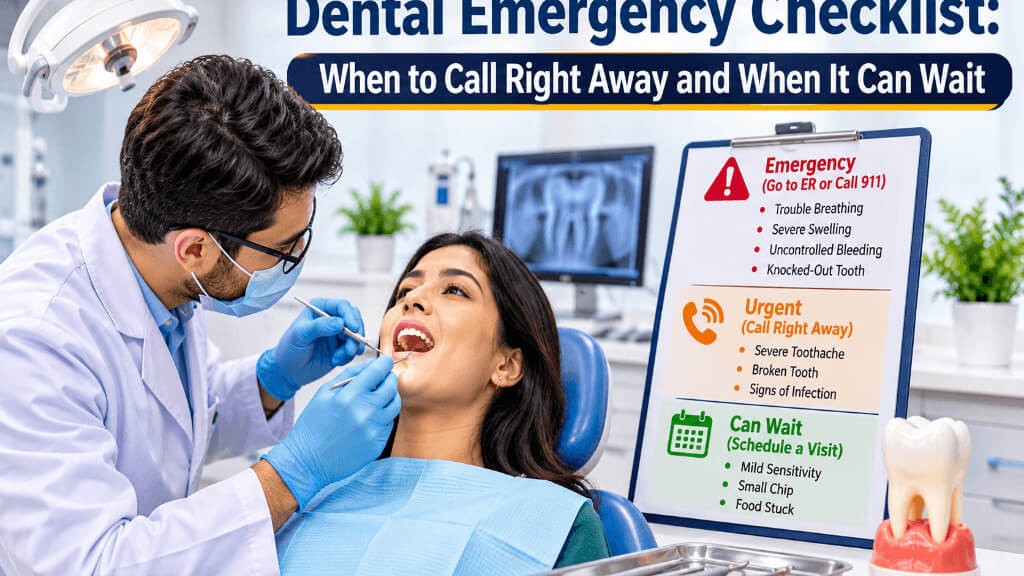
Dental Emergency Checklist: When to Call Right Away and When It Can Wait

Call a dentist right away for uncontrolled bleeding, facial swelling, trouble breathing or swallowing, a knocked-out permanent tooth, severe pain, or signs of a dental infection. Some dental problems can wait for a scheduled appointment, while others need same-day care or emergency medical attention. This guide helps you sort out which is which, without panic.

When something goes wrong with your mouth, it helps to know what can wait and what cannot. This guide is written for adults in tooth pain and for parents handling a child’s dental injury. It also covers broken teeth, lost crowns or fillings, bleeding gums, swelling, and braces problems, and it can help you decide whether a trip to the emergency room is needed..

Dental Emergency Checklist

Go to the emergency room or call 911 now: trouble breathing, trouble swallowing, significant facial swelling, or bleeding that will not stop after gentle pressure with clean gauze.

Call a dentist right away: a knocked-out permanent tooth (keep it moist and handle it by the crown), severe pain, or signs of infection such as swelling, fever, a bad taste, or pus.

Call the same day: a broken or cracked tooth, a persistent toothache, or a lost crown or filling that hurts. Call soon: a broken braces wire that irritates your mouth.

Usually can wait for a scheduled visit: mild sensitivity, a small chip without pain, food stuck between teeth, or minor gum irritation. Call for advice if you are unsure. This is a general guide, and your symptoms may differ.

What Counts as a Dental Emergency?

True Dental Emergencies

These may need immediate care:

  • Uncontrolled bleeding
  • Facial swelling, or trouble breathing or swallowing
  • A knocked-out permanent tooth
  • Severe pain
  • A dental abscess (a pocket of infection near a tooth or gum) or other signs of infection
  • A broken tooth with sharp edges, or other dental trauma

Urgent Dental Problems

These usually need prompt attention, often the same day or next business day:

  • A lost crown or filling
  • A broken or cracked tooth
  • A toothache or gum pain
  • A broken braces wire
  • Wisdom tooth pain

Non-Emergency Issues

These can usually wait for a routine visit:

  • Mild sensitivity
  • A small chip without pain
  • Food stuck between teeth
  • Minor gum irritation

Timing matters because some problems can worsen quickly, while others can wait. Not every dental problem is an emergency, and not every broken tooth needs an emergency visit.

When to Call a Dentist Right Away: Knocked-Out Permanent Tooth

Call right away. The American Dental Association (ADA) explains that a knocked-out permanent tooth should be kept moist, and that you should call the dentist and seek care as soon as possible. The American Association of Endodontists advises seeking care within 30 minutes, though a tooth may sometimes still be saved after an hour or more. If you need an emergency dentist in Commack, call before you head in so the office can prepare.

What to Do

  1. Handle the tooth by the crown (the chewing surface), not the root.
  2. Rinse it gently if it is dirty.
  3. Try to place it back in the socket, if possible.
  4. If you cannot, keep it moist: in milk, between the cheek and gums, or in an ADA-accepted tooth-preservation product.
  5. Call the dentist right away and get there as soon as possible.

What Not to Do

  • Touch or scrub the root
  • Let the tooth dry out
  • Wrap it in a dry tissue
  • Use alcohol, hydrogen peroxide, or harsh chemicals on it
  • Delay care

What this means for you: if a child knocks out a tooth during sports, first check whether it is a permanent tooth or a baby tooth. Baby teeth usually are not put back in the socket, so call the dentist for guidance either way.

When to Go to the Emergency Room

Go to the emergency room or call 911. The ADA and the American Academy of Pediatric Dentistry identify uncontrolled bleeding, facial or oral swelling that may affect the airway, and facial trauma as potentially life-threatening emergencies that need immediate care.

Go for:

  • Trouble breathing or swallowing
  • Significant facial swelling
  • Bleeding that does not stop
  • Fever with swelling
  • Serious facial trauma

Bring your medication list and relevant medical information, and contact the dental office after urgent medical care. Do not wait for symptoms to worsen.

Toothache: When It Can Wait and When It Cannot

Can wait: mild sensitivity, with no swelling. Monitor it and schedule a routine visit.

Call the same day: a severe or persistent toothache, or a toothache that wakes you from sleep.

Call right away or seek urgent care: a toothache with swelling or fever.

The ADA explains that for a toothache you can rinse with warm water, gently floss to remove trapped food, and avoid placing aspirin directly on the tooth or gums. A cold compress can help with swelling. Call the dentist if pain is severe or does not go away.

What this means for you: if you have mild sensitivity but no swelling, you can usually schedule a routine visit. If the pain is severe or returns, call.

Broken, Chipped or Cracked Tooth

Call the same day if the tooth is painful, has sharp edges, or comes with swelling or bleeding. Call for advice if the chip is minor and painless, since it can often wait for a scheduled visit.

The ADA explains that for a cracked tooth you can rinse with warm water and use a cold compress to reduce swelling. Also:

  • Save any broken piece, if you can
  • Avoid chewing on that side
  • Watch for sharp edges that irritate your tongue or cheek

A cracked tooth with no pain still deserves a call, because cracks can worsen over time.

What this means for you: if you break a tooth while eating, rinse gently, keep the piece, and call for guidance. Do not try to glue it back.

Dental Abscess and Swelling

Call right away. A dental abscess is a pocket of infection that can form near a tooth or gum. Only a dentist can diagnose it. Possible symptoms include severe pain, swelling, fever, a bad taste, pus, tender lymph nodes, and trouble swallowing or breathing.

Swelling with fever, trouble breathing, or trouble swallowing needs urgent evaluation. In the meantime:

  • Call the dentist right away, and seek emergency care if symptoms are severe
  • Do not pop or drain the area
  • Do not apply heat
  • Follow the dentist’s instructions

What this means for you: if you have facial swelling and a fever, do not wait for an appointment. Seek urgent care.

Bleeding Gums and Oral Bleeding

Can wait: minor gum bleeding while brushing. Mention it at your next visit. Call soon: gums that bleed often or persistently.

Call right away or go to the ER: bleeding that will not stop, including after an extraction. In the meantime:

  • Rinse gently with warm water
  • Apply gentle pressure with clean gauze
  • Avoid vigorous rinsing and smoking
  • Call the dentist if bleeding continues

Lost Filling, Lost Crown or Broken Braces

Call soon, usually the same day or next business day. A lost filling or crown can leave the tooth exposed and sensitive, and a broken braces wire can poke your cheek or gums.

  • Keep the area clean.
  • Avoid chewing on that side.
  • Use orthodontic wax on a poking wire, if you have it.
  • Do not try to glue a crown back in place.
  • Call your dentist or orthodontist for advice.

If you wear braces, call your orthodontist first about a broken wire.

What this means for you: if you lose a crown or filling but have no pain, swelling, or bleeding, you may be able to wait until the next business day. Call for advice anyway.

When a Dental Issue Can Wait

Schedule a routine visit for mild sensitivity, a small painless chip, food stuck between teeth, or minor gum irritation. Meanwhile, monitor symptoms, keep the area clean, and avoid hard or sticky foods. Call sooner if symptoms worsen.

What to Do When You Call

Have This Ready

  • Your name, date of birth, and phone number
  • Insurance information, if you have it
  • Your medical history, medications, and allergies
  • A description of your symptoms, when they started, and how severe they are
  • Any swelling, bleeding, or fever
  • Any recent dental work or injury

Questions to Ask

  • Is this an emergency, and can I be seen today?
  • What should I do until I arrive?
  • Should I go to the emergency room instead?
  • What should I bring (for example, a tooth or tooth fragment)?

If you are unsure, you can contact Commack Family Dental for urgent dental care and ask for guidance. Do not stop or change prescribed medication unless the prescribing clinician tells you to.

How Commack Family Dental Can Help

Commack Family Dental provides general, restorative, cosmetic, and implant dentistry in Commack, NY, and offers emergency dental care. Dr. Steven Klein has experience in cosmetic, implant, and restorative dentistry, including root canal treatment, and in oral surgery such as extractions, bone grafting, and implant placement.

The office uses an OP300 CT scanner for 3D dental imaging and offers complimentary consultations. It is at 647 Commack Road, Commack, NY 11725. Call 631-759-8284 to ask whether your symptoms need urgent care.

If you are unsure whether your symptoms need urgent care, call Commack Family Dental for guidance and to request an appointment.

Dental Emergency Checklist

  1. Call the dentist for severe pain, swelling, or a fever.
  2. Call right away for a knocked-out permanent tooth.
  3. Call for a broken tooth or a lost filling or crown.
  4. Call if bleeding will not stop.
  5. Go to the emergency room for trouble breathing or swallowing, or severe symptoms.
  6. Bring any broken tooth fragment.
  7. Bring your medication list and relevant medical information.
  8. Follow the dentist’s instructions.
  9. Keep follow-up appointments.

Frequently Asked Questions

Q. What counts as a dental emergency?

A dental emergency may include uncontrolled bleeding, facial swelling, trouble breathing or swallowing, a knocked-out permanent tooth, severe pain, or signs of a dental infection.

Q. When should I go to the emergency room for a dental problem?

Go if you have trouble breathing, trouble swallowing, uncontrolled bleeding, or significant facial swelling. Call 911 if symptoms are severe.

Q. Is a toothache an emergency?

It may be, if the pain is severe or persistent, or paired with swelling, fever, or trouble breathing. Mild sensitivity usually can wait for a scheduled visit.

Q. What should I do if my tooth is knocked out?

Handle the tooth by the crown, keep it moist, and call a dentist right away. Try to place it back in the socket if you can, and do not touch the root.

Q. Is a broken tooth an emergency?

It may be, if it is painful, sharp, or comes with swelling or bleeding. A small, painless chip often can wait, but call for advice.

Q. Can I wait until tomorrow if I have a lost crown or filling?

You may be able to wait until the next business day if there is no pain, swelling, or bleeding. Still call the dentist for advice.

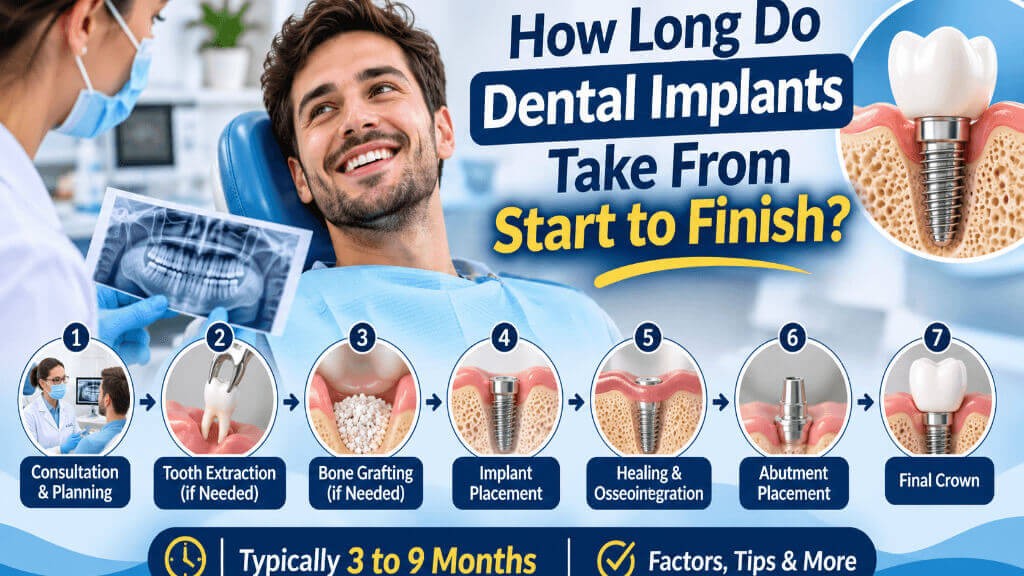
How Long Do Dental Implants Take From Start to Finish?

A dental implant often takes several months from the first consultation to the final crown, with many cases lasting about three to nine months depending on healing, bone support, and whether extra procedures are needed. The placement appointment itself is relatively short. Most of the timeline is healing, especially osseointegration, when the jawbone fuses with the implant.

If you are planning for an implant and want to know what the months ahead will look like, this guide walks you through each stage. It is written for patients missing one or more teeth, including those who may need an extraction or bone grafting first. It also helps anyone weighing an implant-supported bridge or denture, and first-time patients who want the full picture before they begin.

Dental Implant Timeline at a Glance

The process starts with one or two visits for an exam, imaging, and a treatment plan. If a tooth needs to come out, or the jaw needs a bone graft, those steps add weeks or months before the implant goes in. Placement is usually a single visit.

Then comes the longest stage. Osseointegration typically takes about three to nine months, and the abutment (a small connector post) is attached afterward. Gums may need at least two weeks to heal around it before the final crown, bridge, or denture is placed. Follow-up care continues after that. This is a general guide, and individual timelines vary.

What Affects the Dental Implant Timeline?

Two patients can get the same implant and finish months apart. These factors matter most:

  • Number of missing teeth: replacing one tooth may take less planning than several teeth or a full arch.
  • Location: upper back implants may need a sinus lift, and lower jaw implants require careful planning around nerves.
  • Jawbone health: enough bone height, width, and density supports a more straightforward timeline.
  • Extraction or grafting needs: these add healing time before placement.
  • Gum health: gum disease may need treatment first.
  • Medical history and smoking: conditions that affect healing, and smoking, may influence the plan and the pace.
  • Type of restoration: a single crown, bridge, or implant-supported denture needs different planning and visits.
  • Healing response: every patient heals at a different rate.

For a closer look at the factors behind these decisions, see dental implant candidacy.

Step 1: Consultation and Treatment Planning

What Happens at the Consultation

The dentist reviews your medical and dental history, medications, allergies, missing teeth, gum health, bone support, bite alignment, and goals.

Imaging and Diagnostics

You may have dental X-rays, panoramic X-rays, a 3D CT scan, digital impressions, and digital treatment planning. The Commack Family Dental website states that the office uses an OP300 CT scanner, a 3D imaging system that helps inspect patient anatomy.

How Long This Stage Takes

One or more visits, depending on the complexity of your case.

What Happens Next

You receive a treatment plan that may include extraction, bone grafting, a sinus lift, implant placement, a healing period, abutment placement, and the final restoration. Ask for it in writing.

What this means for you: if you have adequate bone and healthy gums, planning may move quickly. If you have gum disease or other issues, your dentist may address them first.

Step 2: Tooth Extraction, if Needed

A damaged or failing tooth may need to come out before an implant. The extraction site may then need time to heal before placement. A socket preservation graft may be placed at the time of extraction to help preserve bone.

What this means for you: if you need an extraction, expect extra healing time before the implant. Ask whether placement can happen sooner in your case.

Step 3: Bone Grafting, if Needed

Bone grafting may be needed when the jaw lacks enough height, width, or density to support an implant. Not every patient needs it. Grafting can add weeks or months to the timeline, and the Cleveland Clinic explains that a bone graft may need at least three months to heal, while larger grafts may take nine to 12 months.

Your dentist will decide whether:

  • The implant can be placed right away
  • A small graft can be placed with the implant
  • The graft must heal before implant placement
  • Another option is more appropriate

What this means for you: if you need a sinus lift for an upper back implant, expect it to happen before placement or, in some cases, during it, depending on your anatomy.

Step 4: Implant Placement

What Happens

The dentist places a titanium implant post into the jawbone. Local anesthesia is commonly used, and sedation may be available for anxious patients.

How Long the Appointment Takes

It depends on the number of implants, the need for grafting, and the complexity of the case.

Healing Cap

A healing cap may be placed over the implant to protect it while it heals. The European Federation of Periodontology explains that it is removed once healing is complete.

What this means for you: if you are anxious about surgery, tell the office beforehand so the team can explain the steps and discuss comfort options.

Step 5: Osseointegration and Healing

What Is Osseointegration?

Osseointegration is the process where the jawbone fuses with the implant. It creates the stable foundation the final restoration needs. The Cleveland Clinic explains that it can take three to nine months, and the European Federation of Periodontology describes implant healing as about two to six months. The range varies by patient and plan.

What to Expect Along the Way

  • First few days: soreness, swelling, bruising, and minor bleeding are common.
  • First week: most patients begin to feel more comfortable.
  • First month: the implant continues to heal and integrate.
  • Several months: osseointegration continues until your dentist confirms the implant is stable.

What Patients Can Do

Follow your post-operative instructions, keep your mouth clean, eat soft foods if advised, avoid smoking and hard or sticky foods, avoid strenuous activity until cleared, and attend follow-up visits. Your dentist may check healing and stability periodically.

Normal Healing vs. Warning Signs

Mild soreness, swelling, and bruising that improve over days are normal. Contact the office if pain or swelling worsens, you notice pus or a bad taste, bleeding does not stop, or the implant feels loose.

Step 6: Abutment Placement

The abutment is a small connector post that attaches to the implant and supports the final restoration. It is placed after the implant has healed and integrated with the jawbone. Mayo Clinic notes that gums may need at least two weeks to heal after abutment placement before the artificial tooth is attached. The European Federation of Periodontology describes the healing cap being replaced with an abutment at this stage.

Step 7: Final Crown, Bridge or Denture

The final restoration is the visible replacement tooth or teeth. It is placed only after your dentist confirms the implant is stable. Common types include:

  • Implant crown: replaces one tooth.
  • Implant-supported bridge: replaces several teeth in a row.
  • Implant-supported denture: replaces multiple or all teeth with a denture supported by implants.
  • Full-arch restoration: replaces all teeth in one arch.

This stage may take one or more visits, depending on the type and whether impressions or digital scans and lab work are needed. For more on crown options, see dental crowns and bridges.

How Long Does Each Stage Take?

Stage Typical timeframe What affects timing
Consultation and planning 1 to 2 visits Complexity, imaging, treatment goals
Tooth extraction, if needed Before implant placement Healing needs, bone preservation
Bone grafting, if needed Weeks to months Graft size, location, healing response
Implant placement 1 visit Number of implants, need for grafting
Osseointegration About 3 to 9 months Bone quality, health, location, healing response
Abutment placement 1 visit Implant stability, gum health
Gum healing after abutment At least 2 weeks Individual healing response
Final restoration 1 or more visits Type of restoration, impressions, lab work
Follow-up care Ongoing Healing, stability, oral health

These are general ranges. Individual timelines vary, and Mayo Clinic notes the entire process can take many months, with much of that time devoted to bone healing.

How Long Does It Take for One Tooth Versus Several?

One Missing Tooth

A patient with adequate bone and healthy gums may finish in several months. A patient who needs an extraction or a graft first will add healing time before placement.

Some patients receive a temporary crown at the time of placement. However, the final crown is usually placed after healing.

Multiple Missing Teeth

An implant-supported bridge, denture, or full-arch restoration can take more planning and more appointments. Multiple implants, grafting, and complex restorations can extend the overall timeline.

What this means for you: if you are considering a bridge or denture on implants, ask how many implants your plan needs and how that affects the number of visits.

How Many Appointments Does a Dental Implant Take?

A typical case may include a consultation, imaging, treatment planning, implant placement, follow-up visits, abutment placement, and the final restoration, plus extraction or grafting visits if needed. The number varies with the number of implants, extraction or grafting needs, the type of restoration, your healing response, and case complexity.

Same-Day Implants

Some patients may be candidates for an immediate temporary crown or restoration. That depends on bone support, gum health, and treatment goals, and it is not an option for everyone. The final restoration still usually comes after healing.

What this means for you: if you want a same-day crown, ask whether your bone and gums make it possible.

What Can Delay a Dental Implant Timeline?

  • Gum disease: may need treatment before placement.
  • Bone loss: may require grafting or extra healing.
  • Smoking: can affect healing and may delay treatment.
  • Medical conditions: conditions that affect healing may change the plan.
  • Infection: may need treatment first.
  • Poor oral hygiene: may increase the risk of complications.
  • Missed appointments: can push back the next stage.
  • Complex restorations: may take longer to plan and fabricate.

What this means for you: if you smoke or have a medical condition, tell your dentist early. It lets the team plan realistic timing.

How to Help Your Implant Stay on Schedule

  • Follow post-operative instructions and take medication as prescribed or recommended.
  • Keep regular dental visits so your dentist can monitor healing.
  • Brush twice daily, clean between your teeth daily, and keep the gumline clean.
  • Avoid smoking, chewing ice, biting hard objects, and using your teeth as tools.
  • Do not ignore gum bleeding or swelling. Call the office.

How Commack Family Dental Can Help

Commack Family Dental provides general, restorative, cosmetic, and implant dentistry in Commack, NY. Dr. Steven Klein has experience in cosmetic, implant, and restorative dentistry, including oral surgery such as extractions, bone grafting, and implant placement. He was awarded a Fellowship in the International Congress of Oral Implantologists.

The office uses an OP300 CT scanner for 3D dental imaging and offers complimentary consultations. It is located at 647 Commack Road, Commack, NY 11725. You can call 631-759-8284 with questions.

Wondering how long a dental implant will take in your case? Schedule a dental implant consultation to review your bone health, gum health, and treatment options.

Dental Implant Timeline Checklist

  1. Schedule a consultation.
  2. Share your medical history and all medications and supplements.
  3. Complete imaging.
  4. Review your treatment plan in writing.
  5. Ask whether you need an extraction, a bone graft, or a sinus lift.
  6. Ask how long healing will take.
  7. Ask how many appointments you will need.
  8. Ask when the final crown will be placed.
  9. Follow post-operative instructions.
  10. Keep follow-up appointments.
  11. Maintain good oral hygiene and avoid smoking.
  12. Contact the office with concerns.

Frequently Asked Questions

Q. How long does a dental implant take from start to finish?

A dental implant often takes several months from consultation to final crown, with many cases lasting about three to nine months. Healing and treatment complexity decide where yours falls.

Q. How long does it take for a dental implant to heal?

Osseointegration, when the jawbone fuses with the implant, can take three to nine months. Some sources describe implant healing as about two to six months, so ask your dentist for your own range.

Q. How long after implant placement can I get my crown?

The final crown is usually placed after the implant has healed and your dentist confirms it is stable. This may take several months.

Q. Does a bone graft make the implant timeline longer?

Yes, bone grafting can add time. The graft may need weeks or months to heal before the implant can be placed.

Q. How many appointments does a dental implant require?

It varies by case. A typical timeline may include a consultation, imaging, treatment planning, implant placement, follow-up visits, abutment placement, and the final restoration.

Q. Can I get a dental implant and crown on the same day?

Some patients may be candidates for an immediate temporary crown. However, the final crown is usually placed after the implant has healed and integrated with the jawbone.

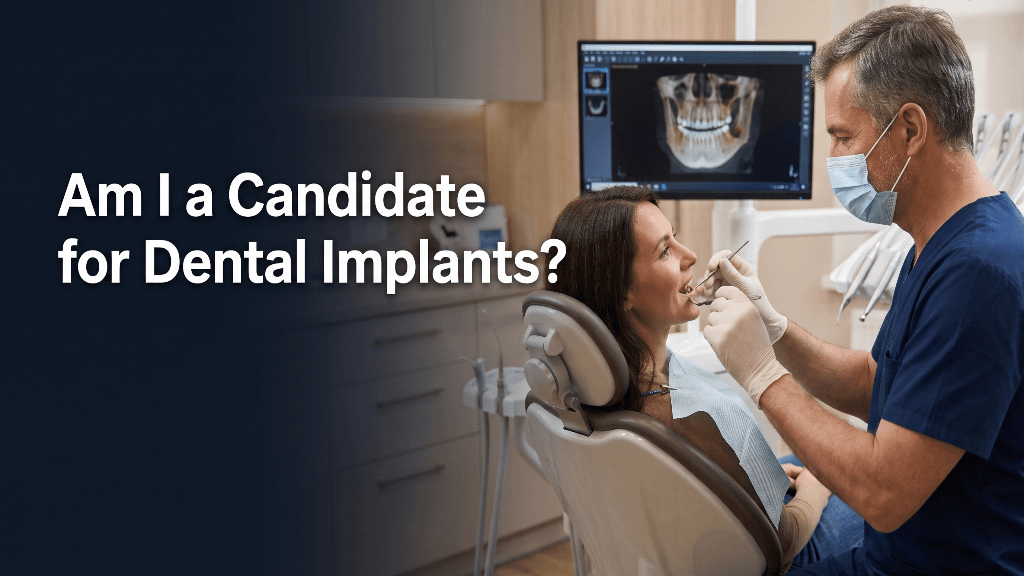
Am I a Candidate for Dental Implants? Bone Loss, Gum Disease and Other Factors

Many adults with missing teeth may be candidates for dental implants, but candidacy depends on your jawbone, gum health, medical history, medications, lifestyle, and the results of a personalized dental evaluation. Bone loss, gum disease, smoking, and certain medical conditions do not automatically disqualify you. However, they may require extra evaluation, treatment, or planning before implant placement.

If you are wondering whether implants are even an option for you, this guide breaks down what dentists look at. It is written for adults with one or more missing teeth, including smokers, former smokers, and patients with bone loss, gum disease, diabetes, or other health conditions. Long-term denture wearers, seniors, and parents asking whether a teen is old enough will also find answers here.

Dental Implant Candidacy at a Glance

Your dentist looks at the whole picture. Missing teeth make you a potential candidate, and the next question is whether your jawbone has enough density and volume to support an implant. Bone loss may call for grafting or additional planning. Healthy gums matter too, and active gum disease may need treatment first.

Smoking can affect healing and long-term implant health, and it raises risk without always ruling out treatment. Medical conditions and medications are reviewed case by case: controlled conditions may still allow implants, while uncontrolled ones may need coordination with your physician. Age matters mainly through jaw growth, and good oral hygiene supports long-term health. Imaging then shows whether the site can support an implant. Only an evaluation can confirm candidacy.

What Does Dental Implant Candidacy Mean?

No single factor decides candidacy. Your dentist weighs your teeth, gums, jawbone, medical history, medications, lifestyle, and goals together, after an exam and imaging. A risk factor does not automatically rule out treatment, and not every patient needs grafting or the same plan. Checking early can spot issues before they become more complex.

How Bone Loss Affects Dental Implant Candidacy

Is There Enough Bone?

Your dentist checks whether your jaw has enough height, width, and density for an implant to stay stable. Bone loss (also called bone resorption) can follow an extraction, long-term tooth loss, gum disease, infection, injury, or years of denture wear.

Does Bone Loss Disqualify You?

No, not automatically. Many patients with bone loss can still become candidates. The real question is whether your site is ready now or needs preparation first.

When Bone Grafting May Be Necessary

Grafting may be recommended when the bone is too thin or too short for the planned implant. The need depends on the implant location, bone volume, and treatment plan. Common examples include socket preservation after an extraction, ridge augmentation to rebuild lost width or height, and a sinus lift in the upper back jaw when bone height is limited.

When Treatment May Need to Be Delayed

Implant placement may wait while a graft heals, while an infection is treated, or while a site recovers after an extraction. In some cases, a small graft can be placed at the same time as the implant. Timing depends on your case.

What this means for you: if you lost a tooth years ago or wore dentures for a long time, expect a close look at bone volume. A delay for preparation does not mean you are out of the running.

How Gum Disease Affects Dental Implant Candidacy

How Gum Health Affects Eligibility

Implants need a healthy foundation. Active or uncontrolled gum disease (periodontal disease) can affect healing and long-term implant health, so your dentist checks gum bleeding, swelling, recession, pocket depth, plaque, bone support, and tooth mobility.

Does Gum Disease Disqualify You?

No, not automatically. Many patients become candidates once the disease is controlled.

When Treatment May Need to Be Delayed

Implant placement may wait until gum disease is treated and stable, and until any infected teeth are addressed. Once you are ready, a history of gum disease may mean more frequent periodontal maintenance and careful home care.

What this means for you: if your gums bleed or you have been told you have gum disease, getting it controlled may be the first step toward implants.

How Smoking Affects Dental Implant Candidacy

How Smoking Affects Healing and Implant Health

Smoking can affect blood flow, healing, and the body’s ability to maintain healthy tissue around an implant. Research reviews associate it with more bone loss around implants and a higher rate of peri-implantitis (inflammation that damages the bone around an implant).

These effects matter at two points: during healing after surgery, and over the years that follow. Grafted sites may also be more sensitive to poor healing, so tobacco use can influence both the plan and the timing.

Does Smoking Disqualify You?

Not automatically. However, smoking may raise risk, and it may call for a more careful treatment plan or a different timeline.

What Your Dentist May Consider

  • How often you smoke or vape, and what you use
  • How long you have used tobacco, or how long ago you quit
  • The current condition of your gums and bone
  • Whether a graft is part of your plan
  • How closely you can commit to follow-up care

Planning Around Tobacco Use

Some dentists ask patients to cut back or stop before and after surgery, and recommendations vary by case. Your dentist and physician can talk with you about options for reducing or quitting. Being honest about your habits helps the team plan realistically.

What this means for you: if you smoke, tell your dentist up front. You may still be a candidate, and the plan may look different from a non-smoker’s.

How Medical Conditions and Medications Affect Candidacy

Some health conditions and medications can affect healing, infection risk, bone health, or treatment planning. Your dentist looks at whether a condition is controlled, how it may affect healing, and whether your physician should be involved. None of these factors automatically disqualifies a patient.

Factor Why it may matter What your dentist may do
Diabetes May affect healing and infection risk, especially if uncontrolled Review how well it is controlled and coordinate with your physician
Osteoporosis or bone medications (such as bisphosphonates) May affect bone healing Review the type of medication and how long you have taken it
Blood thinners or bleeding disorders May affect bleeding during surgery Plan with the prescriber, with no changes on your own
Immune conditions or immunosuppressive medication May affect healing and infection risk Coordinate with your physician
Chemotherapy May affect healing and infection risk Time treatment around your care team’s plan
Head and neck radiation May affect bone healing, and research associates it with higher implant loss Review your radiation details and plan carefully
Pregnancy May affect the timing of elective treatment Discuss your due date and medical history

Diabetes

Research notes that controlled diabetes does not appear to be an absolute contraindication to implants. Uncontrolled diabetes may call for medical coordination and a more careful plan.

What this means for you: if you have diabetes, ask whether your dentist wants to coordinate with your physician before treatment.

Medications

Bring a complete list of everything you take, including prescriptions, supplements, and over-the-counter products. Medications for bone health, blood thinning, or immune suppression are especially important to review. Do not stop or change any prescribed medication unless the prescribing clinician tells you to.

What this means for you: if you take medication that affects bone or bleeding, tell your dentist early, because it may shape the timing and the surgical plan.

Cancer Treatment and Radiation

Chemotherapy and radiation to the head or neck may affect healing and implant planning. If you have a history of either, share detailed treatment information, and expect your dentist to coordinate with your care team.

Other Conditions to Discuss

Tell your dentist about autoimmune conditions, heart conditions, kidney disease, sleep apnea, a history of jaw surgery or facial trauma, and anxiety about surgery. These do not usually end the conversation, but they help your dentist plan safely and plan for your comfort.

How Age and Jaw Growth Affect Candidacy

Jaw Growth and Skeletal Maturity

Implants should not be placed while the jaw is still growing, because an implant does not move with continued growth. Skeletal maturity (whether the jaw has finished growing) matters more than a birthday.

Younger Patients

Younger patients may need to wait until jaw growth is complete. Your dentist can assess growth through an exam and imaging, and may recommend temporary options in the meantime.

Older Adults

Older adults can often be candidates if their gums, bone, and overall health support treatment. Age alone should not be treated as an automatic disqualifier. What counts is your bone, gum health, medical conditions, and medications.

What this means for you: if you are younger, ask whether your jaw has finished growing. If you are an older adult, expect the focus to be on your health and bone, not your age.

How Oral Hygiene Affects Candidacy

Home care matters twice. It can influence whether your dentist is ready to proceed, and it protects the implant afterward, since plaque around an implant can lead to peri-implant disease. Poor hygiene does not automatically disqualify you, but it may need to improve before treatment. Expect to commit to daily brushing, cleaning between teeth, and regular dental visits.

How 3D Imaging Helps Determine Candidacy

Why Imaging Matters for Eligibility

Implant planning commonly includes a 3D scan such as cone beam CT (a scan that creates a three-dimensional image of the jaw). It shows what a regular X-ray cannot: how much bone you have and where nearby structures sit.

What 3D Imaging May Show

  • Bone height, width, and density
  • Nerve position, especially in the lower jaw
  • Sinus position, especially in the upper back jaw
  • Available space for an implant
  • Signs of infection or other changes in the jaw
  • Whether grafting or a sinus lift may be needed

How Imaging Can Change the Plan

If the scan shows enough bone, your dentist may be able to move ahead with planning. If bone is limited, your dentist may recommend grafting or a sinus lift first. If a nerve or sinus is close to the site, your dentist may adjust the planned position or discuss other options. This is why the scan can decide whether you proceed now, later, or in a different way.

Does Every Patient Need a 3D Scan?

No. Imaging recommendations depend on the location, complexity, and treatment plan.

Imaging at Commack Family Dental

The practice lists technology such as 3D dental imaging with CEREC technology, and its website states that the office uses an OP300 CT scanner for 3D imaging.

What this means for you: if you have bone loss or need an upper back implant, ask whether a 3D scan is part of your evaluation.

Other Factors That May Affect Candidacy

  • Number and location of missing teeth: these shape the treatment plan.
  • Bite alignment: bite problems may affect planning.
  • Teeth grinding or clenching: these habits place extra force on implants, so tell your dentist.
  • Previous dental work: crowns, bridges, root canals, extractions, or earlier implants may matter.
  • Sinus anatomy: sinus position may affect planning in the upper back jaw.
  • Nerve position: nerve location may affect planning in the lower jaw.
  • Expectations and follow-up: realistic expectations and a commitment to follow-up care matter.
  • Treatment goals: if the look of the final restoration is a priority, ask about cosmetic dentistry in Commack options too.

What Happens During a Dental Implant Consultation?

Medical and Dental History

The dentist may review your medical history, medications, allergies, dental history, previous extractions or implants, gum disease history, and smoking or tobacco use.

Oral Examination

The dentist may check your missing teeth, gum health, bone support, bite, oral hygiene, neighboring teeth, and existing dental work.

Imaging

The dentist may recommend dental X-rays, panoramic X-rays, a 3D CT scan, or other digital imaging.

Treatment Planning

The dentist will discuss whether implants are appropriate, whether you may need bone grafting or a sinus lift, and the timeline, cost, insurance coverage, financing options, and follow-up care. To start that conversation, you can schedule a dental implant consultation.

Questions to Ask at Your Implant Consultation

  • Based on my exam and imaging, am I a candidate now, or do I need preparation first?
  • How much bone do I have at the site, and is it enough?
  • Does my gum health need treatment before implants?
  • Which of my risk factors (smoking, medical conditions, medications) matter most for my plan?
  • Do you need to coordinate with my physician?
  • What imaging do you need for my case?
  • Might I need grafting or a sinus lift, and would that delay placement?
  • Does my age or jaw growth affect timing?
  • What can I do to improve my candidacy before treatment?
  • If I am not a candidate, what are my alternatives?

If the answer to that last question is a different option, a comparison of dental implants vs. bridges vs. dentures can help you talk through alternatives.

How Commack Family Dental Can Help

Commack Family Dental provides general, restorative, cosmetic, and implant dentistry in Commack, NY. Dr. Steven Klein has experience in cosmetic, implant, and restorative dentistry, including oral surgery such as extractions, bone grafting, and implant placement. He was awarded a Fellowship in the International Congress of Oral Implantologists.

The office uses an OP300 CT scanner for 3D dental imaging and offers complimentary consultations. It is located at 647 Commack Road, Commack, NY 11725, and you can call 631-759-8284 with questions.

Wondering whether dental implants are right for you? Schedule a consultation to review your bone health, gum health, medical history, and treatment options.

Dental Implant Candidacy Checklist

  1. Note how many teeth are missing and where.
  2. Check for gum bleeding, swelling, or recession.
  3. Share your full medical history.
  4. Share all medications and supplements.
  5. Share your smoking or vaping history.
  6. Ask whether you have enough bone, and whether grafting or a sinus lift is likely.
  7. Ask whether gum disease needs treatment first.
  8. Ask whether you need a 3D scan.
  9. Ask how age or jaw growth affects timing.
  10. Ask what could delay treatment and how to improve your readiness.
  11. Schedule a consultation.

Frequently Asked Questions

Q. Can I get dental implants if I have bone loss?

Bone loss does not automatically disqualify you. A dentist may recommend bone grafting or another plan after evaluating your jawbone.

Q. Can I get dental implants if I have gum disease?

Active or uncontrolled gum disease may need treatment before implant placement. Controlled gum disease does not automatically disqualify you.

Q. Can smokers get dental implants?

Smokers may still be candidates, but smoking can affect healing and raise the risk of complications. Discuss your tobacco use with your dentist.

Q. Can I get dental implants if I have diabetes?

Controlling diabetes does not automatically disqualify you. Uncontrolled diabetes may require medical coordination and more careful planning.

Q. How old do I have to be to get dental implants?

Implants are usually placed after jaw growth is complete. Age alone does not determine candidacy, because skeletal maturity, bone health, and oral health matter more.

Q. Do I need a 3D CT scan before dental implants?

Not every patient needs the same imaging. A 3D CT scan may be recommended to evaluate bone volume, nerve position, sinus anatomy, and implant placement.