
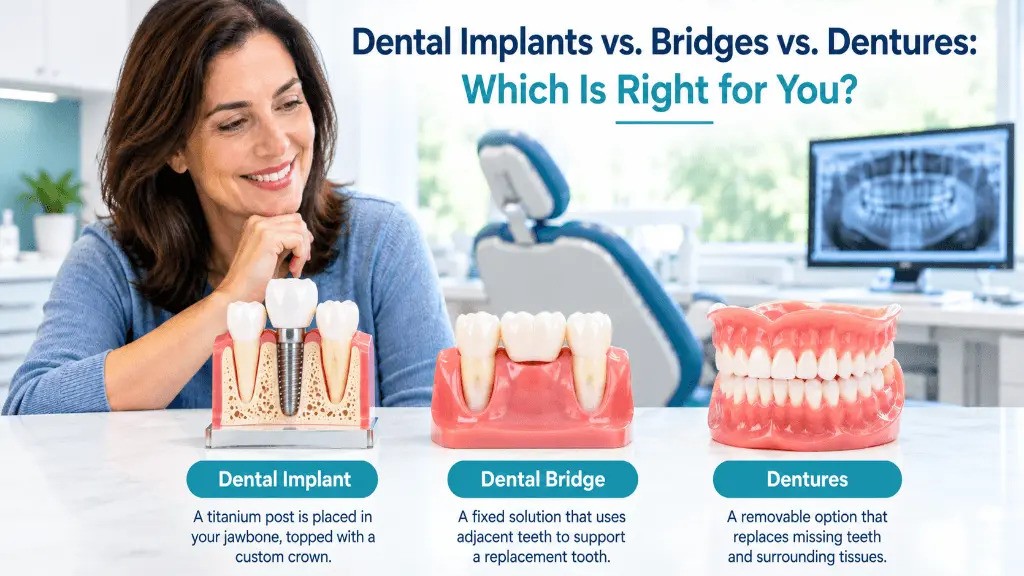
The right choice among dental implants, bridges, and dentures depends on how many teeth are missing, the health of your gums and jawbone, the condition of nearby teeth, your budget, and whether you prefer a fixed or removable solution. There is no single option that suits everyone. Each one has advantages, limitations, and situations where it works well.
If you are living with a gap in your smile, this guide walks you through your options in plain language. It is written for adults missing one tooth or several, first-time implant shoppers, and seniors weighing their choices. It also helps if you are comparing a bridge with an implant, considering full or partial dentures, or trying to decide between a fixed and a removable solution.
Implants, Bridges and Dentures at a Glance
A dental implant is a titanium post placed in the jawbone that supports a crown, bridge, or denture. A bridge replaces missing teeth with artificial teeth supported by nearby teeth or by implants. Dentures are removable appliances that replace several or all missing teeth, and some can be stabilized with implants.
Implants often take longer and cost more upfront, but they replace the tooth root and usually do not require shaping neighboring healthy teeth. Bridges are often quicker, though traditional bridges usually involve reshaping the teeth beside the gap. Dentures can be faster and are often lower in upfront cost, but they may need adjustments and daily care. A dental exam and imaging are needed to find the right fit for you.
Why Replacing Missing Teeth Matters
Effects on Chewing and Speech
Missing teeth can make chewing harder and may affect how you speak.
Effects on Nearby Teeth
Remaining teeth may shift into the space left by a missing tooth. That shifting can change how your teeth fit together.
Effects on Bite and Jaw
Tooth loss can change how your bite works and may affect the jawbone over time, because the bone no longer receives the same stimulation.
Effects on Appearance and Confidence
Missing teeth can change the look of your smile and your face. If appearance is a priority, a dentist can discuss cosmetic dentistry in Commack options alongside the function of each replacement.
Effects on Oral Health
Replacing missing teeth can support long-term oral health. However, the right way to do it depends on your mouth, not a one-size-fits-all rule.
What Are Dental Implants?
How Dental Implants Work
A dental implant is a titanium post placed into the jawbone. After healing, when the bone has fused with the post (a process called osseointegration), the implant can support a crown, bridge, or denture. The American Dental Association (ADA) explains that implants can support a single crown, and that custom bridges or dentures can be made to fit implants when more than one tooth is replaced.
Types of Implant Restorations
- Single implant crown: replaces one tooth and its root.
- Implant-supported bridge: replaces several missing teeth in a row.
- Implant-retained denture: a denture supported by implants, which may be removable.
- Full-arch implant restoration: replaces all teeth in one arch.
Advantages of Dental Implants
- Replaces the tooth root
- Does not usually require shaping nearby healthy teeth
- May help support jawbone health
- Provides a stable foundation for a crown, bridge, or denture
- A fixed implant crown or bridge does not need to be removed for cleaning
Limitations of Dental Implants
- Requires adequate bone support
- May require bone grafting
- Requires healing time
- Involves surgery
- Usually has a higher upfront cost
- Requires good oral hygiene and regular dental care
Who May Be a Good Candidate
Candidates generally need healthy gums, adequate jawbone support, good oral hygiene, controlled medical conditions, realistic expectations, and a commitment to follow-up care. Not every patient is a candidate for implants.
Best for one missing tooth with healthy neighbors: a single implant crown.
Best for long-term stability: implants may suit patients who meet the requirements above.
What Are Dental Bridges?
How Dental Bridges Work
A dental bridge replaces missing teeth with artificial teeth (called pontics) that are supported by nearby teeth or by implants. The ADA explains that a bridge replaces missing teeth with artificial teeth and is attached to surrounding teeth for support. The teeth that hold the bridge are called abutment teeth.
Types of Dental Bridges
- Traditional bridge: crowns on the teeth on both sides of the gap. It usually requires shaping those teeth.
- Cantilever bridge: a crown on one side only. It may provide less support than a traditional bridge.
- Maryland bridge: metal or ceramic wings bonded to nearby teeth. It is often chosen for front teeth and may be less durable.
- Implant-supported bridge: supported by implants instead of natural teeth. It requires implant placement and healing.
The Cleveland Clinic describes these bridge types and notes that cantilever bridges are not as strong as traditional bridges.
Advantages of Dental Bridges
- Can restore chewing and speech
- Can look natural
- Usually does not require surgery when supported by natural teeth
- Can sometimes be completed more quickly than implant treatment
- May cost less upfront than implants
Limitations of Dental Bridges
- Traditional bridges often require reshaping nearby healthy teeth
- Nearby teeth must be strong enough to support the bridge
- Decay or damage to supporting teeth can affect the bridge
- Does not replace the missing tooth root
- Requires careful cleaning around and under the bridge
The Cleveland Clinic notes that decay or trauma affecting abutment teeth can weaken a bridge, and that abutment teeth that are not strong enough may fracture.
Who May Be a Good Candidate
Candidates generally have healthy teeth on one or both sides of the gap, adequate support for the bridge, good oral hygiene, no active gum disease or untreated decay, and a commitment to caring for the supporting teeth.
If your neighboring teeth already need crowns, dental crowns and bridges may be worth discussing, since a bridge can sometimes address both needs.
Best for healthy neighboring teeth or a non-surgical option: a traditional bridge may be considered.
What Are Dentures?
How Dentures Work
Dentures are removable appliances that replace missing teeth and some surrounding tissue. Full dentures replace all teeth in an arch. Partial dentures replace some missing teeth.
Types of Dentures
- Full denture: replaces all teeth in one arch and rests on the gums. It may need adjustments as the mouth changes.
- Partial denture: uses clasps or other connectors around remaining teeth, so those teeth must be healthy enough to support it.
- Immediate denture: inserted the same day remaining teeth are removed. The ADA explains that it may need to be relined or remade after healing.
- Implant-retained denture: attaches to implants. The Cleveland Clinic explains that it does not rely only on the jawbone ridge and gums.
Advantages of Dentures
- Can replace several or all missing teeth
- Usually does not require surgery
- Can restore appearance and function
- May suit patients who cannot have implants or bridges
- Can be more affordable upfront, depending on the case
Limitations of Dentures
- May move or need adjustment
- May take time to get used to
- May affect chewing certain foods
- Requires daily cleaning and proper storage
- Does not replace the tooth root
- May need periodic relining or replacement
Who May Be a Good Candidate
Dentures may suit patients missing several teeth or all teeth in one or both arches, patients with limited bone support for implants, and patients who prefer a removable or non-surgical solution.
Best for all teeth missing: full dentures, implant-retained dentures, or full-arch implant restorations, depending on bone and goals.
Best for a removable solution: conventional dentures.
What this means for you: if you are a senior considering dentures, ask how often fit should be checked. Gums and bone can change over time, and adjustments are normal.
Dental Implants vs. Bridges vs. Dentures: Detailed Comparison
| Factor | Dental implants | Dental bridges | Dentures |
| Number of missing teeth | One or more | One or more | Several or all |
| Surgery | Usually required | Usually not for traditional bridges | Usually not, except implant-retained options |
| Healing time | Longer due to implant healing | Shorter in many cases | Can be faster, especially with immediate dentures |
| Effect on nearby teeth | Minimal for a single implant crown | Traditional bridges may require reshaping | Minimal for conventional dentures |
| Jawbone support | Helps support the jawbone | Does not replace the tooth root | Does not replace the tooth root |
| Stability | Very stable once healed | Stable when supporting teeth are healthy | May move or need adjustment |
| Daily care | Brushing, flossing, regular visits | Cleaning around and under the bridge | Daily cleaning and proper storage |
| Long-term upkeep | Regular visits and good hygiene | Monitoring supporting teeth and bridge | Periodic adjustments or replacement |
| Often suits | A fixed, long-term solution | Healthy supporting teeth | Several or all missing teeth |
This is a general comparison. No option lasts forever without maintenance, and no one can guarantee how many years a restoration will last.
Cost Comparison: Implants, Bridges and Dentures
Cost depends on many factors, and it should not be your only decision point. A lower upfront cost can look different once you consider repairs, adjustments, and replacements over time.
What this means for you: if you want the lowest upfront cost, ask for each option to be priced in writing, including follow-up care. Do not assume which one is lowest until you see your own estimate.
What Affects Dental Implant Cost
- Number of implants
- Need for bone grafting or a sinus lift
- Type of restoration
- Number of missing teeth
- Diagnostic imaging
- Sedation or anesthesia
- Follow-up care
What Affects Dental Bridge Cost
- Number of missing teeth
- Type of bridge
- Materials used
- Need for crowns on supporting teeth
- Need for root canal treatment
- Complexity of the case
What Affects Denture Cost
- Full or partial denture
- Number of teeth replaced
- Materials used
- Need for extractions
- Immediate dentures
- Relining or adjustments
- Implant support
Insurance and Financing
Insurance coverage varies by plan and treatment. Before you start, ask about:
- Covered services
- Annual maximums
- Deductibles
- Waiting periods
- Implant coverage
- Denture coverage
- Financing options
Request a written estimate that includes diagnostics, treatment, materials, follow-up care, and any additional procedures.
How to Choose the Right Tooth-Replacement Option
Best for One Missing Tooth
A single implant crown may be a strong option when bone support is adequate and neighboring teeth are healthy. A traditional bridge may be considered when neighboring teeth already need crowns or when implants are not suitable.
Best for Several Missing Teeth
An implant-supported bridge, a traditional bridge, or a partial denture may be considered, depending on where the teeth are missing and how many.
Best for All Teeth Missing in One Arch
Full dentures, implant-retained dentures, or full-arch implant restorations may be considered.
Best for Limited Bone Support
Bone grafting may be considered before implants. Dentures may be an option when implants are not suitable. If you have gum disease, it usually needs treatment first, whichever option you choose.
Best for a Non-Surgical Approach
Bridges and dentures may suit patients who prefer to avoid surgery.
Best for Long-Term Stability
Implants may offer a stable, long-term solution for suitable candidates. They still require healthy gums, adequate bone, and good maintenance. If you grind or clench your teeth, tell your dentist, because that force can affect any restoration.
Questions to Ask Your Dentist
Bring these questions to your consultation, and ask for the answers in a written treatment plan:
- How many teeth am I missing?
- What is the health of my gums and jawbone?
- Do I have enough bone for implants?
- Do my neighboring teeth need treatment?
- What are all my tooth-replacement options?
- What are the benefits and limitations of each?
- How long will treatment take?
- What will treatment cost?
- What does insurance cover?
- What financing options are available?
- How do I care for each option?
- How long will each option likely last?
- What happens if a restoration needs repair?
- What follow-up care is needed?
You can schedule a tooth-replacement consultation to review these questions with the dentist.
How Commack Family Dental Can Help
Commack Family Dental provides general, restorative, cosmetic, and implant dentistry in Commack, NY. Dr. Steven Klein has experience in cosmetic, implant, and restorative dentistry, including oral surgery such as extractions, bone grafting, and implant placement. He was awarded a Fellowship in the International Congress of Oral Implantologists.
The office also offers CEREC single-visit crowns and Invisalign, and it uses an OP300 CT scanner for 3D dental imaging. Complimentary consultations are available.
The office is at 647 Commack Road, Commack, NY 11725. Call 631-759-8284 to ask a question or book a visit.
Not sure whether an implant, bridge, or denture is right for you? Schedule a consultation to review your oral health, treatment options, timeline, and cost.
Tooth-Replacement Decision Checklist
- Count how many teeth are missing.
- Note where the missing teeth are located.
- Check the health of nearby teeth and gums.
- Ask whether you have enough bone for implants.
- Ask whether a bridge, denture, or implant is recommended.
- Ask about fixed and removable options.
- Ask about treatment time.
- Ask about total cost.
- Ask about insurance and financing.
- Ask about daily care.
- Ask about long-term maintenance.
- Ask about follow-up visits.
- Choose the option that fits your oral health, lifestyle, and budget.
Frequently Asked Questions
Q. What is better, a dental implant or a bridge?
Neither is better for everyone. Implants replace the missing tooth root and do not usually require shaping nearby healthy teeth. Bridges may be a good option when nearby teeth need crowns or implants are not suitable.
Q. Are dentures better than dental implants?
Not always. Dentures may suit patients missing many teeth, patients with limited bone support, or patients who prefer a removable solution. Implants may suit patients seeking a fixed, long-term option.
Q. How long do dental implants, bridges and dentures last?
Longevity depends on oral hygiene, gum health, bite forces, materials, and regular dental care. No option lasts forever without maintenance, and no one can promise a specific number of years.
Q. Which tooth-replacement option is most affordable?
That depends on your case, the materials, your insurance, and your treatment needs. Dentures may have a lower upfront cost in some cases, but implants or bridges may offer different long-term value. A written estimate is the only way to compare.
Q. Can I get implants if I have bone loss?
Bone loss does not automatically rule out implants. A dentist may recommend bone grafting or another plan after evaluating your jawbone.
Q. Can I get an implant-supported denture?
Yes, in suitable cases. Implant-supported dentures use implants to help stabilize a denture, so they may appeal to patients who want more stability than a conventional denture offers.