
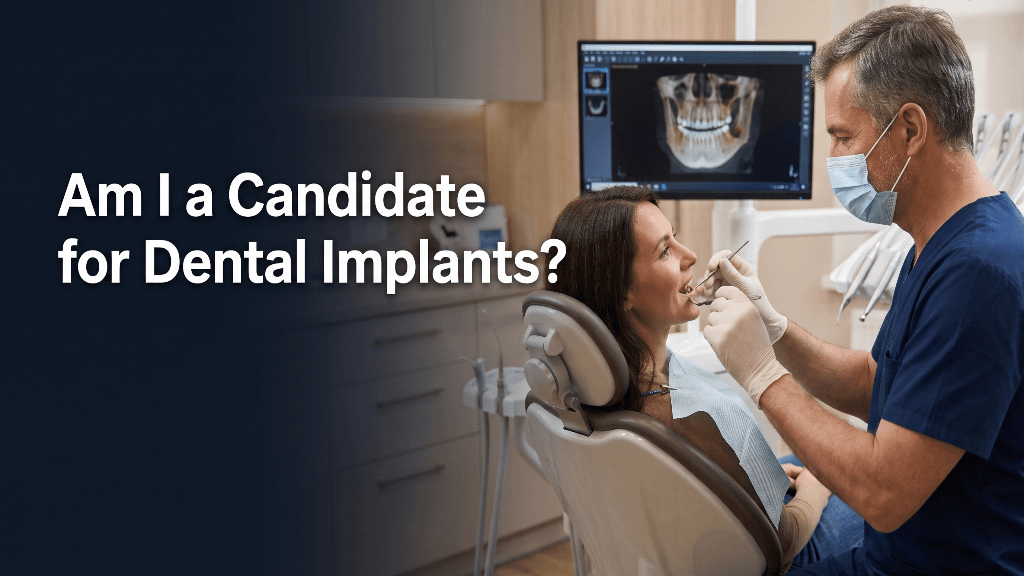
Many adults with missing teeth may be candidates for dental implants, but candidacy depends on your jawbone, gum health, medical history, medications, lifestyle, and the results of a personalized dental evaluation. Bone loss, gum disease, smoking, and certain medical conditions do not automatically disqualify you. However, they may require extra evaluation, treatment, or planning before implant placement.
If you are wondering whether implants are even an option for you, this guide breaks down what dentists look at. It is written for adults with one or more missing teeth, including smokers, former smokers, and patients with bone loss, gum disease, diabetes, or other health conditions. Long-term denture wearers, seniors, and parents asking whether a teen is old enough will also find answers here.
Dental Implant Candidacy at a Glance
Your dentist looks at the whole picture. Missing teeth make you a potential candidate, and the next question is whether your jawbone has enough density and volume to support an implant. Bone loss may call for grafting or additional planning. Healthy gums matter too, and active gum disease may need treatment first.
Smoking can affect healing and long-term implant health, and it raises risk without always ruling out treatment. Medical conditions and medications are reviewed case by case: controlled conditions may still allow implants, while uncontrolled ones may need coordination with your physician. Age matters mainly through jaw growth, and good oral hygiene supports long-term health. Imaging then shows whether the site can support an implant. Only an evaluation can confirm candidacy.
What Does Dental Implant Candidacy Mean?
No single factor decides candidacy. Your dentist weighs your teeth, gums, jawbone, medical history, medications, lifestyle, and goals together, after an exam and imaging. A risk factor does not automatically rule out treatment, and not every patient needs grafting or the same plan. Checking early can spot issues before they become more complex.
How Bone Loss Affects Dental Implant Candidacy
Is There Enough Bone?
Your dentist checks whether your jaw has enough height, width, and density for an implant to stay stable. Bone loss (also called bone resorption) can follow an extraction, long-term tooth loss, gum disease, infection, injury, or years of denture wear.
Does Bone Loss Disqualify You?
No, not automatically. Many patients with bone loss can still become candidates. The real question is whether your site is ready now or needs preparation first.
When Bone Grafting May Be Necessary
Grafting may be recommended when the bone is too thin or too short for the planned implant. The need depends on the implant location, bone volume, and treatment plan. Common examples include socket preservation after an extraction, ridge augmentation to rebuild lost width or height, and a sinus lift in the upper back jaw when bone height is limited.
When Treatment May Need to Be Delayed
Implant placement may wait while a graft heals, while an infection is treated, or while a site recovers after an extraction. In some cases, a small graft can be placed at the same time as the implant. Timing depends on your case.
What this means for you: if you lost a tooth years ago or wore dentures for a long time, expect a close look at bone volume. A delay for preparation does not mean you are out of the running.
How Gum Disease Affects Dental Implant Candidacy
How Gum Health Affects Eligibility
Implants need a healthy foundation. Active or uncontrolled gum disease (periodontal disease) can affect healing and long-term implant health, so your dentist checks gum bleeding, swelling, recession, pocket depth, plaque, bone support, and tooth mobility.
Does Gum Disease Disqualify You?
No, not automatically. Many patients become candidates once the disease is controlled.
When Treatment May Need to Be Delayed
Implant placement may wait until gum disease is treated and stable, and until any infected teeth are addressed. Once you are ready, a history of gum disease may mean more frequent periodontal maintenance and careful home care.
What this means for you: if your gums bleed or you have been told you have gum disease, getting it controlled may be the first step toward implants.
How Smoking Affects Dental Implant Candidacy
How Smoking Affects Healing and Implant Health
Smoking can affect blood flow, healing, and the body’s ability to maintain healthy tissue around an implant. Research reviews associate it with more bone loss around implants and a higher rate of peri-implantitis (inflammation that damages the bone around an implant).
These effects matter at two points: during healing after surgery, and over the years that follow. Grafted sites may also be more sensitive to poor healing, so tobacco use can influence both the plan and the timing.
Does Smoking Disqualify You?
Not automatically. However, smoking may raise risk, and it may call for a more careful treatment plan or a different timeline.
What Your Dentist May Consider
- How often you smoke or vape, and what you use
- How long you have used tobacco, or how long ago you quit
- The current condition of your gums and bone
- Whether a graft is part of your plan
- How closely you can commit to follow-up care
Planning Around Tobacco Use
Some dentists ask patients to cut back or stop before and after surgery, and recommendations vary by case. Your dentist and physician can talk with you about options for reducing or quitting. Being honest about your habits helps the team plan realistically.
What this means for you: if you smoke, tell your dentist up front. You may still be a candidate, and the plan may look different from a non-smoker’s.
How Medical Conditions and Medications Affect Candidacy
Some health conditions and medications can affect healing, infection risk, bone health, or treatment planning. Your dentist looks at whether a condition is controlled, how it may affect healing, and whether your physician should be involved. None of these factors automatically disqualifies a patient.
| Factor | Why it may matter | What your dentist may do |
| Diabetes | May affect healing and infection risk, especially if uncontrolled | Review how well it is controlled and coordinate with your physician |
| Osteoporosis or bone medications (such as bisphosphonates) | May affect bone healing | Review the type of medication and how long you have taken it |
| Blood thinners or bleeding disorders | May affect bleeding during surgery | Plan with the prescriber, with no changes on your own |
| Immune conditions or immunosuppressive medication | May affect healing and infection risk | Coordinate with your physician |
| Chemotherapy | May affect healing and infection risk | Time treatment around your care team’s plan |
| Head and neck radiation | May affect bone healing, and research associates it with higher implant loss | Review your radiation details and plan carefully |
| Pregnancy | May affect the timing of elective treatment | Discuss your due date and medical history |
Diabetes
Research notes that controlled diabetes does not appear to be an absolute contraindication to implants. Uncontrolled diabetes may call for medical coordination and a more careful plan.
What this means for you: if you have diabetes, ask whether your dentist wants to coordinate with your physician before treatment.
Medications
Bring a complete list of everything you take, including prescriptions, supplements, and over-the-counter products. Medications for bone health, blood thinning, or immune suppression are especially important to review. Do not stop or change any prescribed medication unless the prescribing clinician tells you to.
What this means for you: if you take medication that affects bone or bleeding, tell your dentist early, because it may shape the timing and the surgical plan.
Cancer Treatment and Radiation
Chemotherapy and radiation to the head or neck may affect healing and implant planning. If you have a history of either, share detailed treatment information, and expect your dentist to coordinate with your care team.
Other Conditions to Discuss
Tell your dentist about autoimmune conditions, heart conditions, kidney disease, sleep apnea, a history of jaw surgery or facial trauma, and anxiety about surgery. These do not usually end the conversation, but they help your dentist plan safely and plan for your comfort.
How Age and Jaw Growth Affect Candidacy
Jaw Growth and Skeletal Maturity
Implants should not be placed while the jaw is still growing, because an implant does not move with continued growth. Skeletal maturity (whether the jaw has finished growing) matters more than a birthday.
Younger Patients
Younger patients may need to wait until jaw growth is complete. Your dentist can assess growth through an exam and imaging, and may recommend temporary options in the meantime.
Older Adults
Older adults can often be candidates if their gums, bone, and overall health support treatment. Age alone should not be treated as an automatic disqualifier. What counts is your bone, gum health, medical conditions, and medications.
What this means for you: if you are younger, ask whether your jaw has finished growing. If you are an older adult, expect the focus to be on your health and bone, not your age.
How Oral Hygiene Affects Candidacy
Home care matters twice. It can influence whether your dentist is ready to proceed, and it protects the implant afterward, since plaque around an implant can lead to peri-implant disease. Poor hygiene does not automatically disqualify you, but it may need to improve before treatment. Expect to commit to daily brushing, cleaning between teeth, and regular dental visits.
How 3D Imaging Helps Determine Candidacy
Why Imaging Matters for Eligibility
Implant planning commonly includes a 3D scan such as cone beam CT (a scan that creates a three-dimensional image of the jaw). It shows what a regular X-ray cannot: how much bone you have and where nearby structures sit.
What 3D Imaging May Show
- Bone height, width, and density
- Nerve position, especially in the lower jaw
- Sinus position, especially in the upper back jaw
- Available space for an implant
- Signs of infection or other changes in the jaw
- Whether grafting or a sinus lift may be needed
How Imaging Can Change the Plan
If the scan shows enough bone, your dentist may be able to move ahead with planning. If bone is limited, your dentist may recommend grafting or a sinus lift first. If a nerve or sinus is close to the site, your dentist may adjust the planned position or discuss other options. This is why the scan can decide whether you proceed now, later, or in a different way.
Does Every Patient Need a 3D Scan?
No. Imaging recommendations depend on the location, complexity, and treatment plan.
Imaging at Commack Family Dental
The practice lists technology such as 3D dental imaging with CEREC technology, and its website states that the office uses an OP300 CT scanner for 3D imaging.
What this means for you: if you have bone loss or need an upper back implant, ask whether a 3D scan is part of your evaluation.
Other Factors That May Affect Candidacy
- Number and location of missing teeth: these shape the treatment plan.
- Bite alignment: bite problems may affect planning.
- Teeth grinding or clenching: these habits place extra force on implants, so tell your dentist.
- Previous dental work: crowns, bridges, root canals, extractions, or earlier implants may matter.
- Sinus anatomy: sinus position may affect planning in the upper back jaw.
- Nerve position: nerve location may affect planning in the lower jaw.
- Expectations and follow-up: realistic expectations and a commitment to follow-up care matter.
- Treatment goals: if the look of the final restoration is a priority, ask about cosmetic dentistry in Commack options too.
What Happens During a Dental Implant Consultation?
Medical and Dental History
The dentist may review your medical history, medications, allergies, dental history, previous extractions or implants, gum disease history, and smoking or tobacco use.
Oral Examination
The dentist may check your missing teeth, gum health, bone support, bite, oral hygiene, neighboring teeth, and existing dental work.
Imaging
The dentist may recommend dental X-rays, panoramic X-rays, a 3D CT scan, or other digital imaging.
Treatment Planning
The dentist will discuss whether implants are appropriate, whether you may need bone grafting or a sinus lift, and the timeline, cost, insurance coverage, financing options, and follow-up care. To start that conversation, you can schedule a dental implant consultation.
Questions to Ask at Your Implant Consultation
- Based on my exam and imaging, am I a candidate now, or do I need preparation first?
- How much bone do I have at the site, and is it enough?
- Does my gum health need treatment before implants?
- Which of my risk factors (smoking, medical conditions, medications) matter most for my plan?
- Do you need to coordinate with my physician?
- What imaging do you need for my case?
- Might I need grafting or a sinus lift, and would that delay placement?
- Does my age or jaw growth affect timing?
- What can I do to improve my candidacy before treatment?
- If I am not a candidate, what are my alternatives?
If the answer to that last question is a different option, a comparison of dental implants vs. bridges vs. dentures can help you talk through alternatives.
How Commack Family Dental Can Help
Commack Family Dental provides general, restorative, cosmetic, and implant dentistry in Commack, NY. Dr. Steven Klein has experience in cosmetic, implant, and restorative dentistry, including oral surgery such as extractions, bone grafting, and implant placement. He was awarded a Fellowship in the International Congress of Oral Implantologists.
The office uses an OP300 CT scanner for 3D dental imaging and offers complimentary consultations. It is located at 647 Commack Road, Commack, NY 11725, and you can call 631-759-8284 with questions.
Wondering whether dental implants are right for you? Schedule a consultation to review your bone health, gum health, medical history, and treatment options.
Dental Implant Candidacy Checklist
- Note how many teeth are missing and where.
- Check for gum bleeding, swelling, or recession.
- Share your full medical history.
- Share all medications and supplements.
- Share your smoking or vaping history.
- Ask whether you have enough bone, and whether grafting or a sinus lift is likely.
- Ask whether gum disease needs treatment first.
- Ask whether you need a 3D scan.
- Ask how age or jaw growth affects timing.
- Ask what could delay treatment and how to improve your readiness.
- Schedule a consultation.
Frequently Asked Questions
Q. Can I get dental implants if I have bone loss?
Bone loss does not automatically disqualify you. A dentist may recommend bone grafting or another plan after evaluating your jawbone.
Q. Can I get dental implants if I have gum disease?
Active or uncontrolled gum disease may need treatment before implant placement. Controlled gum disease does not automatically disqualify you.
Q. Can smokers get dental implants?
Smokers may still be candidates, but smoking can affect healing and raise the risk of complications. Discuss your tobacco use with your dentist.
Q. Can I get dental implants if I have diabetes?
Controlling diabetes does not automatically disqualify you. Uncontrolled diabetes may require medical coordination and more careful planning.
Q. How old do I have to be to get dental implants?
Implants are usually placed after jaw growth is complete. Age alone does not determine candidacy, because skeletal maturity, bone health, and oral health matter more.
Q. Do I need a 3D CT scan before dental implants?
Not every patient needs the same imaging. A 3D CT scan may be recommended to evaluate bone volume, nerve position, sinus anatomy, and implant placement.